
Connected Home Charger - Speed Decreasing on 100A Circuit

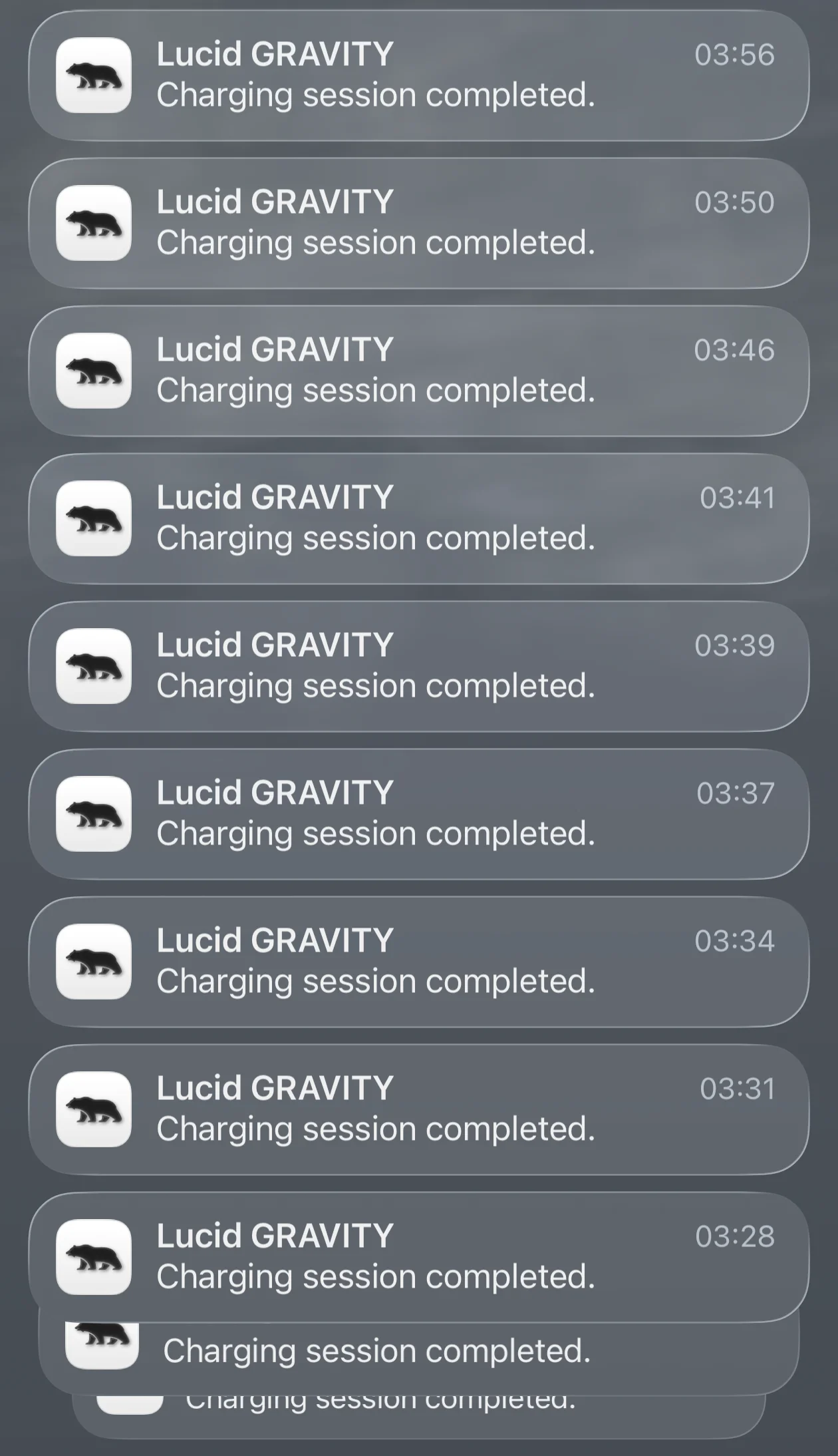
I just tried my 80A Lucid charger on the Gravity at my vacation home. It started out fine at 19kw, but when I checked it at 70%, it would go between 11kW and 14kw. After reaching 80% if would get the charged message repeatedly. I unplugged it at this time.

In the next morning I needed to charge to 100%. I set the charge time to 9:00pm and plugged in. Luckily it did not start. Later on I forced it to start charging. When it was at about 95% I noticed it was only charging at 11kW. I unplugged and plugged back in and it would cycle starting and stopping charging.

I decide to plug the car into my Gen-1 Tesla charger, which is sent to 72A (the highest for Gravity). It fired up and the car started charging at 17kW until it was at 100%.

So my conclusion is that there is something wrong with the Lucid charger. Or the software in the Gravity has some interaction with it - possibly the V2L stuff?

1775518669637.webp
 
I just tried my 80A Lucid charger on the Gravity at my vacation home. It started out fine at 19kw, but when I checked it at 70%, it would go between 11kW and 14kw. After reaching 80% if would get the charged message repeatedly. I unplugged it at this time.

In the next morning I needed to charge to 100%. I set the charge time to 9:00pm and plugged in. Luckily it did not start. Later on I forced it to start charging. When it was at about 95% I noticed it was only charging at 11kW. I unplugged and plugged back in and it would cycle starting and stopping charging.

I decide to plug the car into my Gen-1 Tesla charger, which is sent to 72A (the highest for Gravity). It fired up and the car started charging at 17kW until it was at 100%.

So my conclusion is that there is something wrong with the Lucid charger. Or the software in the Gravity has some interaction with it - possibly the V2L stuff?


View attachment 38064
If you have an older LCHCS, my understanding is there is a newer revision that addresses this issue. They replaced mine and it works fine now.

It was a PITA to get them to replace it, but once they did, it works.
 
If you have an older LCHCS, my understanding is there is a newer revision that addresses this issue. They replaced mine and it works fine now.

It was a PITA to get them to replace it, but once they did, it works.
I have the latest NACS version. I have 3 more same version ones uninstalled too. I need to contact customer care, because waiting for hopeful software upgrade is not working out.
 
I have the latest NACS version. I have 3 more same version ones uninstalled too. I need to contact customer care, because waiting for hopeful software upgrade is not working out.
Yeah, that I have no idea; ours is flawless with the new LCHCS, but it is J1772 w/ the Lucid adapter.
 
I’m still pinning this on a software issue. Maybe they’ve addressed it through their own charger but… too many people still being affected. @marqie any follow up you can share with us on this? Miami service center told me they’ve seen this and one of the guys thinks it was a software revision maybe to help preserve the battery?
 
I’m still pinning this on a software issue. Maybe they’ve addressed it through their own charger but… too many people still being affected. @marqie any follow up you can share with us on this? Miami service center told me they’ve seen this and one of the guys thinks it was a software revision maybe to help preserve the battery?
I'm interested in hearing the answer to this as well. Before I go through the rigmarole of replacing the charger which seemed to be working fine prior to this update but I can't be 100% sure of that.
 
I'm interested in hearing the answer to this as well. Before I go through the rigmarole of replacing the charger which seemed to be working fine prior to this update but I can't be 100% sure of that.
Yeah, if you read the full history of this thread, you’ll see we went through all different types of theories. It started cropping up in May of last year and we thought well maybe it’s the warmer climate. People’s garages are heating up the chargers are overheating, etc. I think for the most part all of that has been debunked just as time as passed, and the situation remains.
 
Yeah, if you read the full history of this thread, you’ll see we went through all different types of theories. It started cropping up in May of last year and we thought well maybe it’s the warmer climate. People’s garages are heating up the chargers are overheating, etc. I think for the most part all of that has been debunked just as time as passed, and the situation remains.
Well the climate here is not the problem for sure. I have a V2 unit in @borski says a V3 unit solves the problem. Unfortunately that involves time and cost to uninstall/reinstall.
 
Well the climate here is not the problem for sure. I have a V2 unit in @borski says a V3 unit solves the problem. Unfortunately that involves time and cost to uninstall/reinstall.
Lucid does reimburse $250 for electrician labor as long as the LHCS was replaced under warranty. you will need to ask for it, as they won't just volunteer it. 😂
 
Lucid does reimburse $250 for electrician labor as long as the LHCS was replaced under warranty. you will need to ask for it, as they won't just volunteer it. 😂
Can confirm this as well.
 
Yeah, if you read the full history of this thread, you’ll see we went through all different types of theories. It started cropping up in May of last year and we thought well maybe it’s the warmer climate. People’s garages are heating up the chargers are overheating, etc. I think for the most part all of that has been debunked just as time as passed, and the situation remains.
It's a Gravity thing, probably related to build(parts) and software...I had an Air rental for 2 weeks and it averaged 75A on my charger for the 2 weeks...We'll see what they say when I drop it off on the 17th for my backseat replacement and another look at what's going on with the charging (3rd time)...
 
It's a Gravity thing, probably related to build(parts) and software...I had an Air rental for 2 weeks and it averaged 75A on my charger for the 2 weeks...We'll see what they say when I drop it off on the 17th for my backseat replacement and another look at what's going on with the charging (3rd time)...
Be careful about making generalizations and blanket statements based on one data point. I'm having that exact problem with my 2022 Air GT. 80AMP, reliably charged at full power for years but now I'm seeing significant variations in charging speed.
 
Yeah, definitely not just a Gravity thing…I am still getting slow charges a year later. I’m finally going to stop being lazy and call Lucid to get the process started to hopefully replace the charger with the v3 version.
 
So, I just contacted customer care and yes, they sent me a request for a bunch of photos and readings from the EVSE. All good, except a bit apprehensive about a few items:

“We need you to measure the voltage and need photos of the readings on your multimeter to determine what might might be the issue.

L1 to Ground (Should be around 120V’s)

L2 to Ground (Should also be around 120V’s)

L1 to L2 (Should be around 240V’s)

Please measure and share the amperage too.”

My multimeter leads are only rated to 20A since I’m not an electrician, so does that matter when testing a charger that is connected to a 100A breaker, or is that only a concern during a charging session? Basically, would the wiring be capable of moving 100A when connecting a multimeter (and thus causing a dangerous issue)? This seems like a large ask for the average user without hiring an electrician. I’m not the average user, but I’m also not an electrician. I know no one is an electrician here, but how did you go about this particular request? Thanks.
 
So, I just contacted customer care and yes, they sent me a request for a bunch of photos and readings from the EVSE. All good, except a bit apprehensive about a few items:

“We need you to measure the voltage and need photos of the readings on your multimeter to determine what might might be the issue.

L1 to Ground (Should be around 120V’s)

L2 to Ground (Should also be around 120V’s)

L1 to L2 (Should be around 240V’s)

Please measure and share the amperage too.”

My multimeter leads are only rated to 20A since I’m not an electrician, so does that matter when testing a charger that is connected to a 100A breaker, or is that only a concern during a charging session? Basically, would the wiring be capable of moving 100A when connecting a multimeter (and thus causing a dangerous issue)? This seems like a large ask for the average user without hiring an electrician. I’m not the average user, but I’m also not an electrician. I know no one is an electrician here, but how did you go about this particular request? Thanks.
This level of power can literally kill you. If you are uncomfortable, get an electrician.
 
This level of power can literally kill you. If you are uncomfortable, get an electrician.
Oh, I know. That’s my point…why are they asking me to measure the amperage of a live 240v connection? I’m very comfortable with switching out the charger with a turned off breaker and torquing the lugs appropriately, but testing a live connection is a very different thing.
 
Clamp ammeters are fairly inexpensive, and could easily measure the charging current if sized appropriately. You might also be able to rent one or borrow one if you don't want to invest in one.
 
Oh, I know. That’s my point…why are they asking me to measure the amperage of a live 240v connection? I’m very comfortable with switching out the charger with a turned off breaker and torquing the lugs appropriately, but testing a live connection is a very different thing.
Typically an electrician would use a clamp-on ammeter. That's who should be taking these measurements if you are not an electrician or electrical engineer.
It's easy enough to make a catastrophic mistake with a DVM, like having it set to measure current when you are trying to check voltage. Unpleasant surprises will result.

One thing that bugs me about this process: The car is measuring the voltage and current it is receiving, and the "connected " LCHCS is as well. But Lucid is asking layperson car owners to open the LCHCS with power on while charging and poke around with a meter. Dangerous.
 
Last edited:
Typically an electrician would use a clamp-on ammeter. That's who should be taking these measurements if you are not an electrician or electrical engineer.
It's easy enough to make a catastrophic mistake with a DVM, like having it set to measure current when you are trying to check voltage. Unpleasant surprises will result.
I agree ☝️
 
I have seen but never purchased a clamp-on meter, and now see now where they are useful. Makes far more sense than the leads…

I’ve many times checked the webpage for the charger to see what measurements it is reporting, so yeah, not sure why the logs won’t suffice.
 
Back
Top