This might shed light on why automakers don’t go “all in” with CarPlay / Android Auto

HC_79

Active Member

Verified Owner
Supporting Member
Joined
Jan 4, 2022
Messages
5,615
Reaction score
10,711
Location
Santa Clarita, CA
Cars
2026 Gravity Dream
Gravity DE Number
68
Referral Code
AWNJLGKT
So the article basically concludes that they cannot monetize the data? lol

And now shifted priorities to aid internally... which is not really an argument at all since you still have that available with CP/AA.

At this point if I were them I would think fuller CP/AA to attract more customers is more worth it to get even larger customer base for more data to have better chance to monetize.

In any case it will be interesting to see what happens next few years.
 
Main benefit is Dolby Atmos in Amazon Music? They can still offer that as a separate amazon music app...no need to remove android auto or carplay.

The routing with charging data is helpful, I agree. But how often do you take long trips? For that few times a year, I don't want to be without apple carplay.

I'm NEVER buying a car without apple carplay again. I use it all the time in my Lucid, much better integration into my music, messages, calls etc.

GM like car companies just gaslighting to initiate subscription services down the line. They will lose a LOT of customers.
 
You want to create a better car and keep me as a customer? Give me what I want: CarPlay and/or Android Auto.
Exactly. No CarPlay then you don’t get any future business from me, which similar opinion of majority of people I know.
 
I recall reading that article last year.
It makes sense to me.

I'm not the type of customer that says "just give me what I want".
Especially when I understand the reasons (data access for product improvement, in-house product development).
Sometimes customers think they know what they want, but that's sometimes based on limited access to information.
If carmakers simply gave customers what they want, basic ADAS features would be optional because people can't be bothered with information/warnings intended to save themselves and others. Whose got time for that!?

Posts in the 3.5.1 thread had also suggested what the article reveals.
 
I recall reading that article last year.
It makes sense to me.

I'm not the type of customer that says "just give me what I want".
Especially when I understand the reasons (data access for product improvement, in-house product development).
Sometimes customers think they know what they want, but that's sometimes based on limited access to information.
If carmakers simply gave customers what they want, basic ADAS features would be optional because people can't be bothered with information/warnings intended to save themselves and others. Whose got time for that!?

Posts in the 3.5.1 thread had also suggested what the article reveals.
Finally! Someone read and took the message from the article properly.
 
Finally! Someone read and took the message from the article properly.
Data monetization was mentioned, but the intent of product development and improvement was pretty clear. Even for those (hello GM) who initially sought monetary gain.
 
It's like you read what you want to read and not to the very end of the article you are posting
So far, the pure monetary value of the data they have been collecting hasn’t lived up to expectations, primarily because most car companies don’t have the technical competency to properly profit from it in the manner of tech giants, according to Hart. While the business case is clear in areas such as insurance, GM’s experience has tempered those expectations, and parsing and putting all that data collection to use has been challenging, to put it mildly.

Given the myriad issues, data mining and monetization strategies have largely been put on hold. “They’re not really prioritizing it, and there’s no big expectations that data is going to be a cash cow,” Hart said. “The emphasis has shifted toward how they can leverage data internally to help improve their processes, efficiencies, warranty, and customer service—areas they feel there are much more direct and quantifiable returns.”
 
It's like you read what you want to read and not to the very end of the article you are posting
Yep……

“Given the myriad issues, data mining and monetization strategies have largely been put on hold. “They’re not really prioritizing it,”
 
Yep……

“Given the myriad issues, data mining and monetization strategies have largely been put on hold. “They’re not really prioritizing it,”
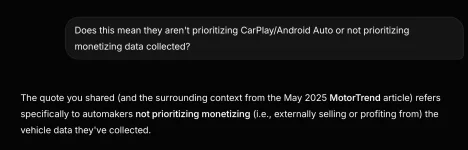
Um, English isn't my first language, but I'm fairly sure that means they aren't prioritizing monetizing data... lol
 
I posted that last year

 
Definitely enlightening articles, but as a consumer I'd like to at least have the choice.

Once the Lucid interface catches up, I will gladly switch away. But it will require calendar integration with my phone, navigation integration with my calendar, reliable two way texting, and Apple Music as a standalone app.
 
So at least one AI agrees with my understanding, whew.

So, if carmakers are unable the monetize the data that is supposedly the main reason for not all in on CP/AA... kind of negates everyone's main point about it? lol....

If GM, with so many cars, is unable to monetize their vast data... what chance does smaller car companies like Rivian and Lucid have with their small user base?

Don't really think this article helps the anti CP/AA case here.

Consumers may not know what they want, but businesses also are just as likely to make mistakes.
 

Attachments

  • 1774203612070.webp
    1774203612070.webp
    38.9 KB · Views: 102
Um, English isn't my first language, but I'm fairly sure that means they aren't prioritizing monetizing data... lol
Sorry, I misread your original post. You’re right, they’ve shifted away from the monetization aspect but the data is better in their hands than Apple or Google so they can use it to improve the overall owner experience.

Software is going to be the differentiator when it comes to vehicles now and into the future. That data tracking is going to be critical for an automaker to set themselves apart from the rest. If all that data is being taken by Google and Apple then the automaker has no chance of setting themselves apart because they’re locked out of it.

Interestingly, I can’t remember what button it was on the cockpit but Lucid actually removed it because the data showed them that no one hardly used that button. That’s the real value in data, seeing what users do and don’t do and change the software to reflect that.
 
Sorry, I misread your original post. You’re right, they’ve shifted away from the monetization aspect but the data is better in their hands than Apple or Google so they can use it to improve the overall owner experience.

Software is going to be the differentiator when it comes to vehicles now and into the future. That data tracking is going to be critical for an automaker to set themselves apart from the rest. If all that data is being taken by Google and Apple then the automaker has no chance of setting themselves apart because they’re locked out of it.

Interestingly, I can’t remember what button it was on the cockpit but Lucid actually removed it because the data showed them that no one hardly used that button. That’s the real value in data, seeing what users do and don’t do and change the software to reflect that.
I agree they should use their own data to improve themselves. I guess my point is it is not mutually exclusive and needn't be made out to be. Having CP/AA doesn't mean they don't have access to that data anymore.

Also, implementing CP/AA is probably even more human resource lighter than before with AI agents. They could probably let an intern do it totally independently.

Meanwhile they improve their own native offerings and it's a win-win for everyone.
 
Um, English isn't my first language, but I'm fairly sure that means they aren't prioritizing monetizing data... lol
Correct. The point is this was never really about monetizing the data but, as @msaunders9430 pointed put, “data access for product improvement, in-house product development”, etc.
 
I agree they should use their own data to improve themselves. I guess my point is it is not mutually exclusive and needn't be made out to be. Having CP/AA doesn't mean they don't have access to that data anymore.

Also, implementing CP/AA is probably even more human resource lighter than before with AI agents. They could probably let an intern do it totally independently.

Meanwhile they improve their own native offerings and it's a win-win for everyone.
The issue is that CP/AA is a black box; so if a customer is using Google Maps, instead of native nav, a manufacturer has no idea how to improve their nav as all that data is gone. Just as one example. So clearly, in some cases at least, “Having CP/AA” does “mean they don't have access to that data anymore”
 
The issue is that CP/AA is a black box; so if a customer is using Google Maps, instead of native nav, a manufacturer has no idea how to improve their nav as all that data is gone. Just as one example. So clearly, in some cases at least, “Having CP/AA” does “mean they don't have access to that data anymore”
I'm interested in this case, because to me, they still have the car's nav/location/SOC data. What data would they lose here exactly?
 
I agree they should use their own data to improve themselves. I guess my point is it is not mutually exclusive and needn't be made out to be. Having CP/AA doesn't mean they don't have access to that data anymore.
This is partially true. They have the same access to the data the car provides to CP/AA.

But they don't have access to the UX data about what the user is doing with the apps running on the phone. At most they have screen touch data, but no context.
 
Back
Top