
Cell temp rise during Level 2 charging at low rate

electric

Active Member

Verified Owner
Supporting Member
Joined
Sep 27, 2025
Messages
291
Reaction score
639
Location
Sacramento area
Cars
Gravity
I have my home charger capped at 40A (10kW charging limit) due to garage wiring limitation.
I consider this a relatively low rate of charge for a 120kWh battery, it's a puny C/12 rate of charge.
Today I was charging the battery from 37% to 80%, which is also quite normal.
I did not expect the car to throttle the charge rate before reaching 80% when charging at such low rate, but noticed it was at 4kW when it was only 70%.
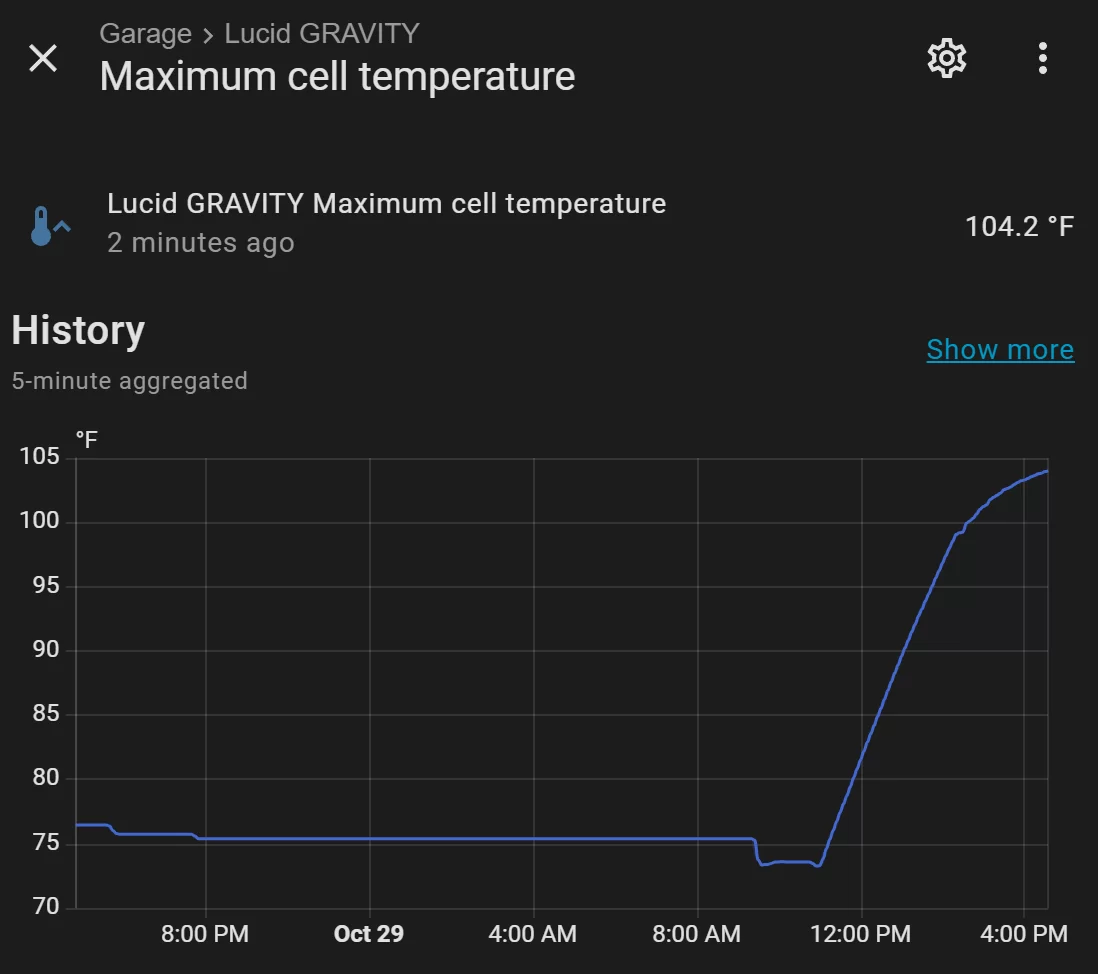
I suspected the throttle is related to max cell temp, which is exposed thru Home Assistant integration, so I grabbed this graph.
I'm surprised to see such rapid temp rise at such low charge rate and low SOC, it's clearly imposing the limit on the charge rate.

I'm very familiar with lithium battery technology, it's part of my professional work, so I understand the principles and mechanisms involved.
My only concern is how steep the curve is for such large battery in such mundane conditions and I have no reference points to know if this is normal for Lucid in general, normal for Gravity, or something I should be concerned with.

Please keep it technical and to the point, I don't need general education, I've been in EV business for 17 years.
I just want to compare notes with others who have relevant data.
Thank you.
1761781623051.webp
 
I have my home charger capped at 40A (10kW charging limit) due to garage wiring limitation.
I consider this a relatively low rate of charge for a 120kWh battery, it's a puny C/12 rate of charge.
Today I was charging the battery from 37% to 80%, which is also quite normal.
I did not expect the car to throttle the charge rate before reaching 80% when charging at such low rate, but noticed it was at 4kW when it was only 70%.
I suspected the throttle is related to max cell temp, which is exposed thru Home Assistant integration, so I grabbed this graph.
I'm surprised to see such rapid temp rise at such low charge rate and low SOC, it's clearly imposing the limit on the charge rate.

I'm very familiar with lithium battery technology, it's part of my professional work, so I understand the principles and mechanisms involved.
My only concern is how steep the curve is for such large battery in such mundane conditions and I have no reference points to know if this is normal for Lucid in general, normal for Gravity, or something I should be concerned with.

Please keep it technical and to the point, I don't need general education, I've been in EV business for 17 years.
I just want to compare notes with others who have relevant data.
Thank you.

View attachment 33856
You made me check, but over the last two weeks or so the Air has seen a max of 90-91F and the Gravity a max of 100-101F or so. The curve for the Gravity looks similar to yours.

1761798336308.webp
 
I have my home charger capped at 40A (10kW charging limit) due to garage wiring limitation.
I consider this a relatively low rate of charge for a 120kWh battery, it's a puny C/12 rate of charge.
Today I was charging the battery from 37% to 80%, which is also quite normal.
I did not expect the car to throttle the charge rate before reaching 80% when charging at such low rate, but noticed it was at 4kW when it was only 70%.
I suspected the throttle is related to max cell temp, which is exposed thru Home Assistant integration, so I grabbed this graph.
I'm surprised to see such rapid temp rise at such low charge rate and low SOC, it's clearly imposing the limit on the charge rate.

I'm very familiar with lithium battery technology, it's part of my professional work, so I understand the principles and mechanisms involved.
My only concern is how steep the curve is for such large battery in such mundane conditions and I have no reference points to know if this is normal for Lucid in general, normal for Gravity, or something I should be concerned with.

Please keep it technical and to the point, I don't need general education, I've been in EV business for 17 years.
I just want to compare notes with others who have relevant data.
Thank you.

View attachment 33856
From 12 to 4pm it rose from 80F to 104F and that is considered rapid? I guess it looks like from 12 -2 it went from 80 to 100. Just curious as I’m trying to to learn these things. What maximum cell temp should the pack be at when L2 charging, 80-85?
 
Are we saying we need an industrial fan in the garage to get the best charge rates at home?

This would be pretty bad on a DC fast charger on a hot day, maybe?
 
Known issue at least on our end in the ownership experience. A closed garage traps the heat, and warm to hot days compound the issue. Fans will kick in and exacerbate the issue in a vain attempt to reduce system temperatures.

The throttling here I suspect is the resolution to that problem. 10kwh is a lot of energy being moved over several hours. The thermal heat loss due to inefficiencies in charging adds up.
 
Oh, I missed that. Mine doesn’t throttle. I’ll double check but I’m pretty sure.
 
I am wondering if it's by design? The capacity at 100 Deg F is higher than 75 Deg F, so as the SOC gets up to 80% it tries to do it on purpose as part of BMS thermal management? I used the API with my Air and it would generally do about 3.5 DEG F per hour at 8kw Charge rate, but that is at lower SOC. Agree with @Rogue too, heat soak over several hours in a closed garage.

Was the OP cooling fan running? The other thing that is possible is not 'throttling' but any cabin cooling, BMS cooling or other aux system power draw comes off the charge rate when plugged in.
 
It was definitely running the cooling system, but not as crazy as it does on a fast DC charger.
Reduced charge rate was confirmed at the charger, so it's not siphoning to other systems, it is throttling battery charge rate.
My garage ambient is not hot in this season, much cooler than it would be in the summer, so it's not heat soaking the ambient space.
My concern is that I expected such massive battery, capable of insane DC charge rates, to suck up puny 10kW all day long with no throttle until at least 95% SOC, but it trottles to 4kW at 70% with 30F temp rise inside of 4 hours. Not having previous reference points for Lucid Gravity I found this surprisingly limiting.
Usually I charge overnight and don't care if it takes an extra 1-2 hours to get to 80%, but this time I forgot to plug in the night before, so I charged during the day and happened to be looking at data in real time.
I'm not saying there is something wrong with my car or Gravity design, but I suspect there can be future software improvements in Level 2 charge management, for example crank up the cooling system even when running Level 2 charge when observing cell temp rise.
Another observation is that I updated to 3.3.8 right before this charge cycle and release notes mention some changes in Level 2 charging, so maybe there is a connection with software update.

@borski what was your charge rate when your graph data was collected? Looks like you had about 20F rise in about 2 hours, similar to mine.
 
10kwh is a lot of energy being moved over several hours. The thermal heat loss due to inefficiencies in charging adds up.
In my experience C/12 charge rate is quite slow and 10kW is not a lot power for such massive battery.
Most heat loss is in the charger electronics doing AC/DC conversion, but it should not heat up cells, which are thermally insulated from power electronics and have active cooling available.
Charger itself has a much larger temp envelope and also has active cooling.
Even my Chevy Bolt EV with half the size battery can run 10kW all the way above 80% without throttle, but it does crank the cooling to maintain the charge rate.
I can't imagine it being normal when such massive and advanced EV as Gravity can't sustain 10kW charge rate for a few hours.
 
Most heat loss is in the charger electronics doing AC/DC conversion, but it should not heat up cells, which are thermally insulated from power electronics and have active cooling available.
But which coolant loop is the AC/DC (aka wunderbox) on? If it's shared with the battery that could explain it.
Also, maybe they don't run the heat pump during L2 charging to save energy. I think even if they're not on the same loop they could be configuring it to use the battery as a thermal mass.
 
Last edited:
Also, maybe they don't run the heat pump during L2 charging to save energy. I think even if they're not on the same loop they could be configuring it to use the battery as a thermal mass.
Do you think that 10kW Level 2 charge rate should be continuously sustainable by any reasonable design for EV of this size?
Note that 20kW Level 2 rate is supposedly supported, although I don't have a 100A circuit to test it in my house.
When you design it for 20kW, should it be able to do 10kW all day long and not drop to 4kW after 3-4 hours?
In my experience with large lithium batteries, anything slower than C/5 should run continuously with little to no active cooling, and I'm doing C/12 here, which is much much slower.
 

Ok fine to keep the technical stuff here but there is a thread with people voicing concerns over charger throttling.

I only see throttling when charging above 56a.
 
I have no expertise here but have been charging my Gravity on a 60A circuit regularly up to 80% and the charging speed/rate has never been throttled all the way up to 80%.
 

Ok fine to keep the technical stuff here but there is a thread with people voicing concerns over charger throttling.

I only see throttling when charging above 56a.
Thank you for the link, I did not come across that thread, it might be something similar to what I'm seeing.
I need to collect a lot more data before coming to any conclusions, it was just one charge cycle that I accidentally observed, from now on I will pay more attention.
That is after I get my Gravity back from service, hopefully next week. Meanwhile I can charge Air Pure loaner from the same home charger and compare data.
 
Thank you for the link, I did not come across that thread, it might be something similar to what I'm seeing.
I need to collect a lot more data before coming to any conclusions, it was just one charge cycle that I accidentally observed, from now on I will pay more attention.
That is after I get my Gravity back from service, hopefully next week. Meanwhile I can charge Air Pure loaner from the same home charger and compare data.
I’d be curious to see what your air pure curve looks like.

That other thread is long, but we’ve been trying to narrow it down for months as to what the issue is. It happens on the Lucid home charger as well as the Tesla GEN three charger. Perhaps some other others as well. The complaint started rolling in around May of this year when an update came out I believe off memory 2.6.8. Basically after about 30 to 35 minutes of charging many of us are getting throttle down to 7 or 8 kW and ultimately down to 6 or 7 kW. Prior to that time I never had any issue charging and maintaining the full 48 A 11.5 KW. I got the Car in March and there was never an issue until May. I should also say that I’ve used that same charger on my two prior Tesla’s with zero issues.

So there you go. Interested to hear your thoughts from someone in the industry.
 
Thank you for the link, I did not come across that thread, it might be something similar to what I'm seeing.
I need to collect a lot more data before coming to any conclusions, it was just one charge cycle that I accidentally observed, from now on I will pay more attention.
That is after I get my Gravity back from service, hopefully next week. Meanwhile I can charge Air Pure loaner from the same home charger and compare data.
more data is always a welcome thing! eager to see what you turn up!
 
Do you think that 10kW Level 2 charge rate should be continuously sustainable by any reasonable design for EV of this size?
Note that 20kW Level 2 rate is supposedly supported, although I don't have a 100A circuit to test it in my house.
When you design it for 20kW, should it be able to do 10kW all day long and not drop to 4kW after 3-4 hours?
In my experience with large lithium batteries, anything slower than C/5 should run continuously with little to no active cooling, and I'm doing C/12 here, which is much much slower.
Well it's certainly not "compromise nothing". lol. I would be annoyed if I needed the charge and I was forced to pay for electricity at a fast charger.
I agree with you that it's not the batteries creating the heat. It's probably that they're running coolant through the AC/DC and the battery, the motor coolant loop would probably be too hot. Obviously the car is capable of cooling the battery so they're probably doing it to save energy. MPGe includes charging losses so cooling the battery would make that number worse. Which I don't love because the battery will degrade much faster at 102F vs. 80F.
 
I agree with you that it's not the batteries creating the heat. It's probably that they're running coolant through the AC/DC and the battery, the motor coolant loop would probably be too hot. Obviously the car is capable of cooling the battery so they're probably doing it to save energy. MPGe includes charging losses so cooling the battery would make that number worse. Which I don't love because the battery will degrade much faster at 102F vs. 80F.
During charge it's perfectly acceptable to reach and stay at up to 113F without abnormal degradation, so I'm surprised to see reduced rate when it's only at 104F.
In fact, I made an assumption that rate reduction is even related to cell temp rise, correlation doesn't mean causation, but I don't have any other important temp data exposed thru API.
It's possible that another temp sensor somewhere is imposing the limit, or software set envelope is too narrow for some reason only Lucid would know, maybe some liability concern or some hardware defect or discovered issue which prompted them to impose a tighter software limit. We can be guessing all day with no actual data to back up these theories.
But at least I now know there is a precedent in Air community of something similar and it's worth keeping an eye on and collecting data.
Appreciate everyone's feedback!
 
From 12 to 4pm it rose from 80F to 104F and that is considered rapid? I guess it looks like from 12 -2 it went from 80 to 100. Just curious as I’m trying to to learn these things. What maximum cell temp should the pack be at when L2 charging, 80-85?
Regardless of charging method the max cell temp should be not higher than 113F, although some exceptions are possible to allow even higher temp under certain controlled conditions.
Rate of cell temp rise is a function of charge rate, it should be slow on a large, heavy battery with lots of thermal mass which is charging at a fraction of 1C rate and has active cooling available. It should be dissipating heat fast enough that it's not accumulating and causing rapid temp rise. My gut feeling is that 10F rise per hour when charging at C/12 rate is not ideal, but it depends on what Lucid is optimizing for, maybe they optimize for efficiency and don't want to increase cooling, sacrificing the rate.
 
@borski what was your charge rate when your graph data was collected? Looks like you had about 20F rise in about 2 hours, similar to mine.
1761878165410.webp
 
Back
Top