
- Joined
- Mar 7, 2020
- Messages
- 8,700
- Reaction score
- 14,395
- Location
- Naples, FL
- Cars
- Air DE-P, 2 Gravity DEs
- Air DE Number
- 395
- Gravity DE Number
- 067
238
- Referral Code
- 033M4EXG
What follows is a highly-anecdotal story that is of little value other than conveying the general mix of charging confidence and anxiety this long-time EV owner still experiences when road tripping. So read further only if you're interested (or maybe a bit bored):
We owned Teslas from 2015 to 2024 and have owned Lucids (an Air since 2021 and Gravities since mid-2025) and have seen a lot of evolution -- including progress, stalls, and dead ends -- with the road charging landscape in those eleven years. There is a lot of regionality to the charging picture in the U.S., with the West Coast in the best shape, the East Coast somewhat more spotty, and parts of the vast expanse between still pitifully covered, especially if you venture off an interstate highway.
We spent the last week driving up Interstate I-75 from Naples, FL almost to the southern Tennessee border, with more than a dozen charging stops. They weren't all necessary, but we wanted to check out some sites we had used (or attempted to use) on earlier trips to see their current state.
First stop was an Electrify America station at the University Town Center Mall in Sarasota, Florida. We first used this station successfully several years ago in our Air. Last year we tried it with our Gravity, only to find it was completely shut down due to an equipment upgrade. Several months ago we tried it again with the Gravity. 5 of the 6 stalls were occupied, and the 6th one was out of service. There were several cars waiting to charge, so we moved on to a nearby Tesla Supercharger. Last week we tried again. We arrived before the mall opened, and all the stalls were empty. We plugged in and charged for a few minutes just to be sure it was working. We were at a fairly high state of charge already so couldn't really judge the kW output fairly.
In Macon, GA we tried a Georgia Power / ChargePoint station we had used successfully a couple of years ago. There were only two DCFC stalls. One was occupied by a Cadillac Lyriq, and we took the other one. We plugged in, initiated charging through the ChargePoint app, and got the "Preparing to Charge" notice on the car screen. Five minutes in, we were still getting no juice and seeing this:
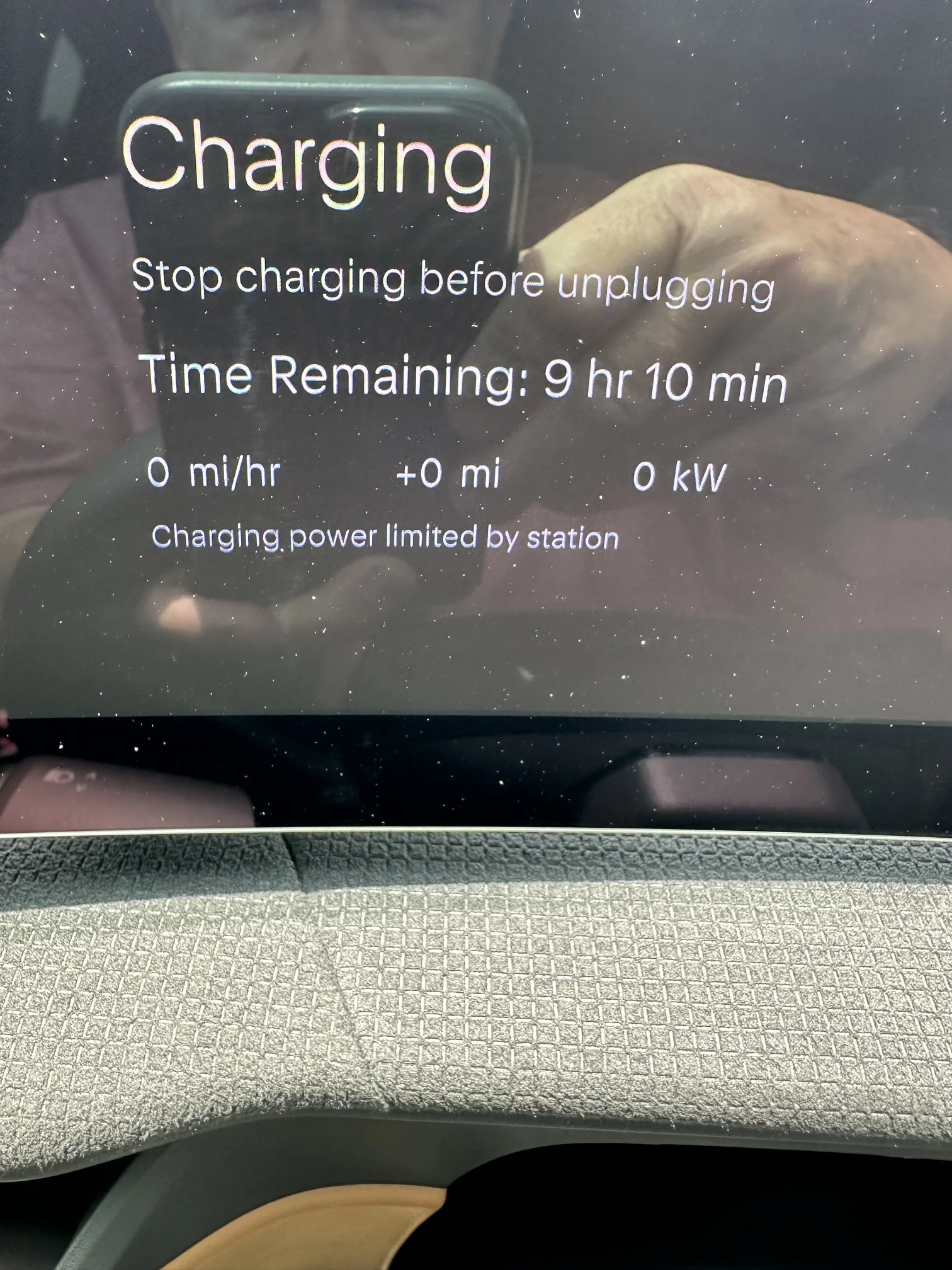
Our hotel room was not yet ready, thus we had some time to kill and decided to wait a bit longer. Finally, the Lyriq finished charging and drove off. Suddenly our car started charging. But even though this was a 125 kW station and we were below 50% SOC, the charge rate started at only 43 kW and promptly dropped to 29 kW. Then the charging suddenly stopped even though we were the only car at the station. We waited a while longer to see if charging would restart. It never did.
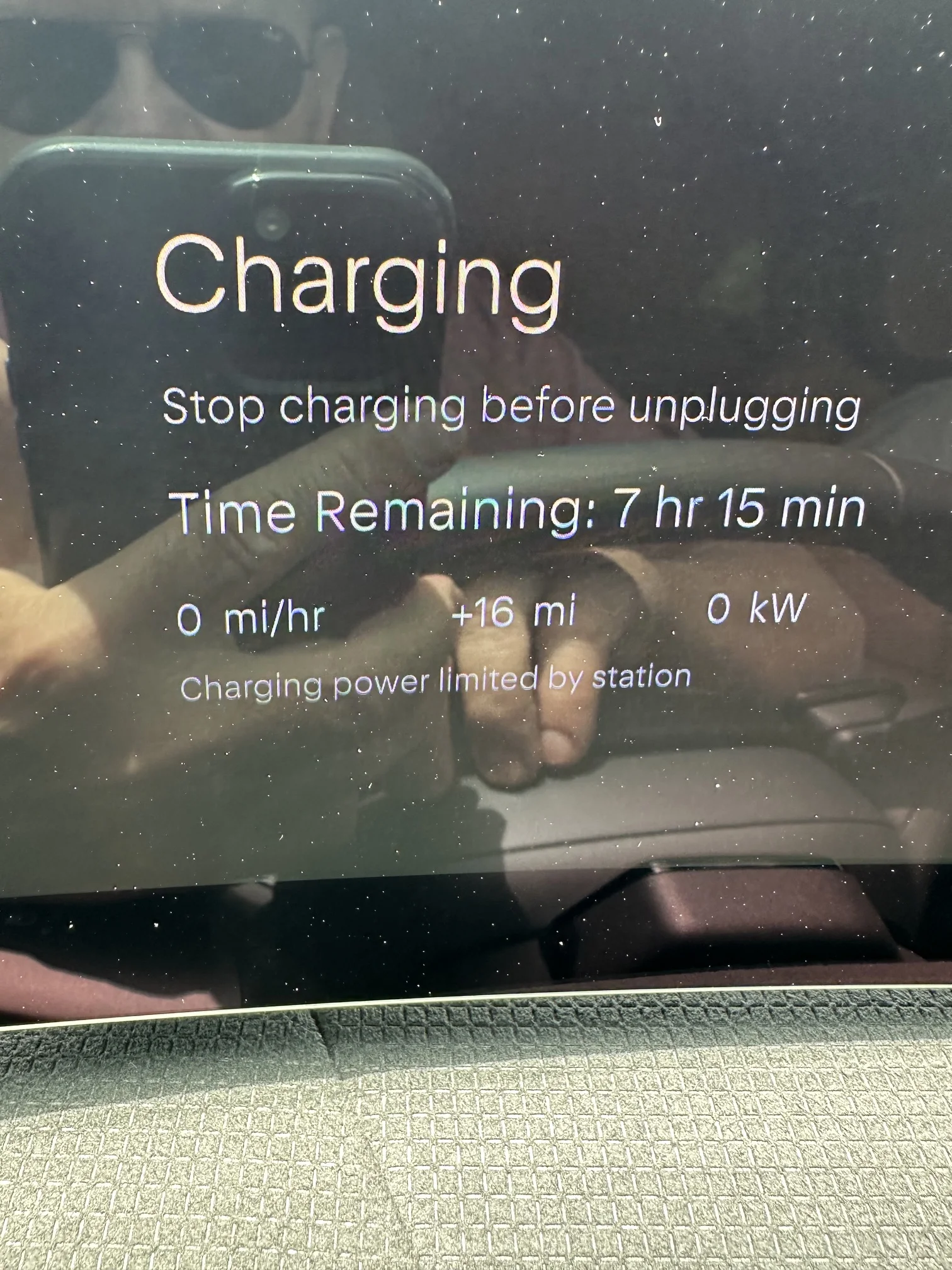
After spending 30 minutes at this station, this was the final outcome -- a measly 16 miles of range added:
There was not another DCFC in Macon (other than an old V2 Supercharger station that Lucids can't use), but there was a Tesla V3 Supercharger about 20 miles north of Macon, so we decided we'd just charge there the next morning. I've tried ChargePoint chargers several times in the four+ years we've had the Lucids, and we've only been able to charge successfully about half the time. So, along with Electrify America, I consider it highly risky to rely on them if you arrive at a station without an alternative charge service within your remaining range.
The rest of our stops were at Superchargers. All were busy, but all had at least a couple of stalls available. Only once did we find an Individual stall out of service (in McDonough, GA). And all the stations were busy enough that we never got anywhere near the charge speed capability of the Gravity, as output was limited by the station, not by the car. However, we never had to spend more than 25 minutes at a station, even if we were pushing the SOC above 90%.
There was one real oddity, though, with a Supercharger station that was interesting:
A friend had told me there were Tesla Superchargers at a Buc-ee's just south of Macon. Buc-ee's is fairly new to Georgia, and I had never been to one. But I had used the Tesla website to make a list of the NACS-partner Superchargers we might want to use on the trip, as I was not quite ready to trust the Gravity's navigation system to identify them accurately. The Buc-ee's site did not show on the Tesla website until I turned the NACS-partner filter off. This Buc-ee's is huge, with 44 V3 Tesla stalls and 10 MB/Ionna stalls. (16 of the Tesla stalls had the older cabinets, and 28 had the new cabinets with longer cables, although all are V3's.) So I figured it must be one of those V3 sites that Tesla does not make available to non-Teslas due to high demand
However, we wanted to check out the Buc-ee's, anyway, so we decided to give it a try for charging to see what would happen. Then the situation got weirder. The Tesla website said the Buc-ee's was in Fort Valley, GA. The Gravity nav system said it was in Byron, GA. Google said it was in Warner Robins, GA. Yet all showed the same street address of 7001 Russell Parkway. Yes, this Buc-ee's is enormous -- but not that enormous. (I grew up nearby, and these are clearly separate towns with their own administrations, separate police forces, etc.)
But, any-hoo, we pulled up to a Supercharger to see what would happen. I have the Tesla subscription plan and always initiate the charge through the Tesla app instead of via Lucid plug-and-charge in order to get the lower charge fee. However, the site was not showing on the Tesla app. So I plugged in via Lucid plug-and-charge, expecting to find that the site was not available to non-Teslas. To my surprise, charging commenced immediately.
We also planned to try out the MB chargers, but they only had CCS plugs. (I thought they would be equipped with both plugs since they're so new.) It was starting to rain, and I did not want to dig the adapter out from under the luggage in the back of the car, so we decided to try them on another trip.
Final Takeaways:
Tesla still offers the only truly reliable DCFC network . . . and even it can have its burps. One of the GREAT features of the Gravity is that it can use most of that network as seamlessly as any Tesla, especially now that Lucid has (I think) integrated their plug-and-charge with the Tesla subscription plan so that you can get the lower fee without having to bother with the Tesla app (which is usually pretty straightforward, too).
BUT . . . don't ever let the charge in your EV get low enough that you can't make it to an alternative site if the one you planned to use is having issues. It's a very rare occurrence with Superchargers, but the odds with any other charge provider get worse, sometimes considerably so. (Remember that even these days, Kyle Connor lets his cars run down to zero SOC only with a generator truck keeping up the rear.)
We owned Teslas from 2015 to 2024 and have owned Lucids (an Air since 2021 and Gravities since mid-2025) and have seen a lot of evolution -- including progress, stalls, and dead ends -- with the road charging landscape in those eleven years. There is a lot of regionality to the charging picture in the U.S., with the West Coast in the best shape, the East Coast somewhat more spotty, and parts of the vast expanse between still pitifully covered, especially if you venture off an interstate highway.
We spent the last week driving up Interstate I-75 from Naples, FL almost to the southern Tennessee border, with more than a dozen charging stops. They weren't all necessary, but we wanted to check out some sites we had used (or attempted to use) on earlier trips to see their current state.
First stop was an Electrify America station at the University Town Center Mall in Sarasota, Florida. We first used this station successfully several years ago in our Air. Last year we tried it with our Gravity, only to find it was completely shut down due to an equipment upgrade. Several months ago we tried it again with the Gravity. 5 of the 6 stalls were occupied, and the 6th one was out of service. There were several cars waiting to charge, so we moved on to a nearby Tesla Supercharger. Last week we tried again. We arrived before the mall opened, and all the stalls were empty. We plugged in and charged for a few minutes just to be sure it was working. We were at a fairly high state of charge already so couldn't really judge the kW output fairly.
In Macon, GA we tried a Georgia Power / ChargePoint station we had used successfully a couple of years ago. There were only two DCFC stalls. One was occupied by a Cadillac Lyriq, and we took the other one. We plugged in, initiated charging through the ChargePoint app, and got the "Preparing to Charge" notice on the car screen. Five minutes in, we were still getting no juice and seeing this:
Our hotel room was not yet ready, thus we had some time to kill and decided to wait a bit longer. Finally, the Lyriq finished charging and drove off. Suddenly our car started charging. But even though this was a 125 kW station and we were below 50% SOC, the charge rate started at only 43 kW and promptly dropped to 29 kW. Then the charging suddenly stopped even though we were the only car at the station. We waited a while longer to see if charging would restart. It never did.
After spending 30 minutes at this station, this was the final outcome -- a measly 16 miles of range added:
There was not another DCFC in Macon (other than an old V2 Supercharger station that Lucids can't use), but there was a Tesla V3 Supercharger about 20 miles north of Macon, so we decided we'd just charge there the next morning. I've tried ChargePoint chargers several times in the four+ years we've had the Lucids, and we've only been able to charge successfully about half the time. So, along with Electrify America, I consider it highly risky to rely on them if you arrive at a station without an alternative charge service within your remaining range.
The rest of our stops were at Superchargers. All were busy, but all had at least a couple of stalls available. Only once did we find an Individual stall out of service (in McDonough, GA). And all the stations were busy enough that we never got anywhere near the charge speed capability of the Gravity, as output was limited by the station, not by the car. However, we never had to spend more than 25 minutes at a station, even if we were pushing the SOC above 90%.
There was one real oddity, though, with a Supercharger station that was interesting:
A friend had told me there were Tesla Superchargers at a Buc-ee's just south of Macon. Buc-ee's is fairly new to Georgia, and I had never been to one. But I had used the Tesla website to make a list of the NACS-partner Superchargers we might want to use on the trip, as I was not quite ready to trust the Gravity's navigation system to identify them accurately. The Buc-ee's site did not show on the Tesla website until I turned the NACS-partner filter off. This Buc-ee's is huge, with 44 V3 Tesla stalls and 10 MB/Ionna stalls. (16 of the Tesla stalls had the older cabinets, and 28 had the new cabinets with longer cables, although all are V3's.) So I figured it must be one of those V3 sites that Tesla does not make available to non-Teslas due to high demand
However, we wanted to check out the Buc-ee's, anyway, so we decided to give it a try for charging to see what would happen. Then the situation got weirder. The Tesla website said the Buc-ee's was in Fort Valley, GA. The Gravity nav system said it was in Byron, GA. Google said it was in Warner Robins, GA. Yet all showed the same street address of 7001 Russell Parkway. Yes, this Buc-ee's is enormous -- but not that enormous. (I grew up nearby, and these are clearly separate towns with their own administrations, separate police forces, etc.)
But, any-hoo, we pulled up to a Supercharger to see what would happen. I have the Tesla subscription plan and always initiate the charge through the Tesla app instead of via Lucid plug-and-charge in order to get the lower charge fee. However, the site was not showing on the Tesla app. So I plugged in via Lucid plug-and-charge, expecting to find that the site was not available to non-Teslas. To my surprise, charging commenced immediately.
We also planned to try out the MB chargers, but they only had CCS plugs. (I thought they would be equipped with both plugs since they're so new.) It was starting to rain, and I did not want to dig the adapter out from under the luggage in the back of the car, so we decided to try them on another trip.
Final Takeaways:
Tesla still offers the only truly reliable DCFC network . . . and even it can have its burps. One of the GREAT features of the Gravity is that it can use most of that network as seamlessly as any Tesla, especially now that Lucid has (I think) integrated their plug-and-charge with the Tesla subscription plan so that you can get the lower fee without having to bother with the Tesla app (which is usually pretty straightforward, too).
BUT . . . don't ever let the charge in your EV get low enough that you can't make it to an alternative site if the one you planned to use is having issues. It's a very rare occurrence with Superchargers, but the odds with any other charge provider get worse, sometimes considerably so. (Remember that even these days, Kyle Connor lets his cars run down to zero SOC only with a generator truck keeping up the rear.)
Last edited:


