
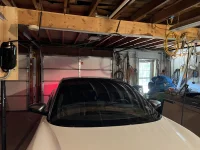
I have enough cable length to just lay it on the garage floor around the front of the car and plug it in on the left side of the car. Not elegant but very functional.I did similar and then got tired of wet dirty charging cable and strung it via bungee cords to go over the car and drop down net to the charge port.
I currently have a sheep halter hanging down until I can find some nice holster
You are using an out of date browser. It may not display this or other websites correctly.
You should upgrade or use an alternative browser.
You should upgrade or use an alternative browser.
Wall charger placement?
- Thread starter Rhinoww
- Start date

- Joined
- Aug 23, 2025
- Messages
- 791
- Reaction score
- 459
- Cars
- Lucid Air Grand Touring
Same but I thought I’d try it so when I got home I left the car outside and found that it actually reachedI have enough cable length to just lay it on the garage floor around the front of the car and plug it in on the left side of the car. Not elegant but very functional.
What have you got to lose?
- Joined
- Aug 23, 2025
- Messages
- 791
- Reaction score
- 459
- Cars
- Lucid Air Grand Touring
- Joined
- May 27, 2026
- Messages
- 342
- Reaction score
- 456
- Location
- Southern CA
- Cars
- Gravity Grand Touring
- Referral Code
- 6298AY75
I actually really like this, I may try to rig up something similar.If you look carefully you can see that the cable can reach across the top if you want to keep the cable clean and out of the way
Next to clean it up for a more finished look yet retaining the ability to easily charge in the other stall or outside
- Joined
- Aug 23, 2025
- Messages
- 791
- Reaction score
- 459
- Cars
- Lucid Air Grand Touring
I kind of like the idea of a swing arm that pivots at the chargerI actually really like this, I may try to rig up something similar.
Not sure how rigid I can make it while keeping the mass low and easy to pivot
Counter balance is one thing but droop is a separate issue
300+ miles is a lot of running errands in one day!Yeah, the convenience is hard to beat! I’m on a TOU plan also, so both vehicles start charging at 10 pm. I believe it’s 48 amp. Takes quite awhile for the Lucid to charge up. When I’m running errands during the day, I usually come back and top it up in between to 80% before 4pm. (When rates spike).
Even at my highest TOU cost I still think it’s cheaper than most of these superchargers and EA chargers are nowadays.
I'm surprised it would need top-ups during the day as well, even with alternating overnights on the charger.
Last edited:
- Joined
- May 27, 2026
- Messages
- 342
- Reaction score
- 456
- Location
- Southern CA
- Cars
- Gravity Grand Touring
- Referral Code
- 6298AY75
I don’t need to top it up every time per se, I just prefer to have it ready to go at 80% at a minimum.300+ miles is a lot of running errands in one day!
I'm surprised it would need top-ups during the day as well, even with alternating overnights on the charger.
I did some of that at first but then settled into a pattern of just plugging in at home when I fall below 50%. (Which is usually only once a week, since we're retired.)I don’t need to top it up every time per se, I just prefer to have it ready to go at 80% at a minimum.
One wishlist item I'd like is the ability to set a chime reminder when exiting the car to plug in if below a set %.
- Joined
- Jan 3, 2022
- Messages
- 7,560
- Reaction score
- 8,666
- Location
- San Francisco Bay Area
- Cars
- Gravity GT, XC40 P8 EV
- Referral Code
- 3OKY7YGA
If you have the interest, you could do that with Home Assistant, sending a notification to your phone or announcing on your home smart speakerrs....One wishlist item I'd like is the ability to set a chime reminder when exiting the car to plug in if below a set %.
It's not the everyday that's a problem. I just got my Lucid but I've had my Lightning since 2022 (with 300m range) and what becomes an issue is when you come home from a long trip and roll into the driveway with somewhere around 30-40 miles left (or even fewer). You can't really go anywhere with that until you charge. So if you have to grab groceries or you happen to come home late in the afternoon and you're in an expensive electricity state like CA you are going to want to charge quickly within a relatively short window even if it's just to get 100 miles into the "tank."300+ miles is a lot of running errands in one day!
I'm surprised it would need top-ups during the day as well, even with alternating overnights on the charger.
Also, if you have solar like me, you'd prefer to charge in the morning when the sun is out vs. after 9pm overnight. And if you have two EVs, like I do, you may want to charge both within the 8 hours that everyone keeps saying it takes to charge their EV overnight.
And lastly I paid for 80A onboard chargers on both vehicles for these reasons and I want to use them
 There's also a very minor consideration that charging faster results in less overhead charging losses but that's just icing on the cake given how minute that issue is in practical terms.
Oh yeah, I know there's fringe exceptions where someone might need a super-fast home charge (80A). Some people live hours from a DCFC station, or drive 200+ miles a day, etc. Although I'd guess that's very rare.It's not the everyday that's a problem. I just got my Lucid but I've had my Lightning since 2022 (with 300m range) and what becomes an issue is when you come home from a long trip and roll into the driveway with somewhere around 30-40 miles left (or even fewer). You can't really go anywhere with that until you charge. So if you have to grab groceries or you happen to come home late in the afternoon and you're in an expensive electricity state like CA you are going to want to charge quickly within a relatively short window even if it's just to get 100 miles into the "tank."
Also, if you have solar like me, you'd prefer to charge in the morning when the sun is out vs. after 9pm overnight. And if you have two EVs, like I do, you may want to charge both within the 8 hours that everyone keeps saying it takes to charge their EV overnight.
And lastly I paid for 80A onboard chargers on both vehicles for these reasons and I want to use them
We have 2 EVs as well, and road trip a lot where we arrive home from a trip at 10-15%. Plugging in overnight at 24A won't quite get me to 80% by 8am the next morning, but it'll still get me to like 60% which is way more than enough for anything I might need to do the next day (especially with the Gravity's range). After a road trip, I'm usually sleeping in the next morning anyway.
 But again, I know there are rare exceptions where someone might need 300 miles by early morning. (Although if I did, I still have plenty to reach a DCFC station.)
I have a 40A Grizzl-E, that I have dialed down to 24A because I just don't need to charge any faster, and less power is both safer and reduces the demand charge from my power company. Some people have unusually high power needs, but I just wanted to point out that for most people, one 32A or 40A EVSE (40A or 50A circuit) is plenty for the vast majority of needs, and that most people don't really need to go to that extent. It's a more difficult lift for many houses and electrical services to add a 100A circuit. A 50A circuit is often more readily available, easier, and cheaper.
Just to clarify so we're not talking past one another: I'm not trying to use edge case scenarios to justify charging at a faster rate. The point I was trying to make was to clarify that a faster charger helps in regular occurring situations (albeit not necessarily everyday) but the conversation tends to revolve around the lower and upper edges of a charge. That is, similar to your response here, it's either 20 miles or 300 miles under consideration.
A more common concern is returning home from a trip and needing an extra ~50 miles, which even at 80A takes an hour. At 40A it's nearly two hours and once you drop it down to 24A like you did it's no longer tenable to "quickly" charge and get back on the road even for a quick jaunt.
Your post that I originally responded to was tongue-in-cheek pointing fun at someone running 300 miles of errands so I was suggesting the more likely scenario people will often find themselves confronted by. And even if it only happens a few times a month or a few times a year that's not really what I would consider an edge case so much as a real variable some families would have to deal with often enough to consider (and for those of us with kids, 300 miles in a day turns out to not be a whole lot on any given weekend).
Relying on DC chargers in most places around SoCal is an exercise in frustration and massive lines/wait times especially in places with high concentrations of EVs, which is most places EV drivers will find themselves in my experience. EV ownership is still highly correlated with wealth/income and all three are not evenly distributed among the population.
But I do agree that if you're considering adding a new panel to add a 100A circuit then that's something that must be considered. It's just a separate point from "do people really need 80A charging?"
A more common concern is returning home from a trip and needing an extra ~50 miles, which even at 80A takes an hour. At 40A it's nearly two hours and once you drop it down to 24A like you did it's no longer tenable to "quickly" charge and get back on the road even for a quick jaunt.
Your post that I originally responded to was tongue-in-cheek pointing fun at someone running 300 miles of errands so I was suggesting the more likely scenario people will often find themselves confronted by. And even if it only happens a few times a month or a few times a year that's not really what I would consider an edge case so much as a real variable some families would have to deal with often enough to consider (and for those of us with kids, 300 miles in a day turns out to not be a whole lot on any given weekend).
Relying on DC chargers in most places around SoCal is an exercise in frustration and massive lines/wait times especially in places with high concentrations of EVs, which is most places EV drivers will find themselves in my experience. EV ownership is still highly correlated with wealth/income and all three are not evenly distributed among the population.
But I do agree that if you're considering adding a new panel to add a 100A circuit then that's something that must be considered. It's just a separate point from "do people really need 80A charging?"
- Joined
- Aug 23, 2025
- Messages
- 791
- Reaction score
- 459
- Cars
- Lucid Air Grand Touring
Without reading any further in the thread …I did some of that at first but then settled into a pattern of just plugging in at home when I fall below 50%. (Which is usually only once a week, since we're retired.)
One wishlist item I'd like is the ability to set a chime reminder when exiting the car to plug in if below a set %.
Home assistant can do this, the Lucid program includes quite a few capabilities I was unaware of.
Ah, you mean same day, not the next day. That's not one I'd have ever thought of... getting home from a long day of driving on a road trip, plugging in for an hour and then heading out immediately to do another 50 miles in the same vehicle.A more common concern is returning home from a trip and needing an extra ~50 miles, which even at 80A takes an hour. At 40A it's nearly two hours and once you drop it down to 24A like you did it's no longer tenable to "quickly" charge and get back on the road even for a quick jaunt.
Once we get home home from a long drive day, we're usually done for the day.


- Joined
- Aug 23, 2025
- Messages
- 791
- Reaction score
- 459
- Cars
- Lucid Air Grand Touring
Reverse the order and you have the scenarioAh, you mean same day, not the next day. That's not one I'd have ever thought of... getting home from a long day of driving on a road trip, plugging in for an hour and then heading out immediately to do another 50 miles in the same vehicle.
Once we get home home from a long drive day, we're usually done for the day.
Short drive then a long drive but to far for the remaining power after the short drive so you have to leave late or stop for a charge on the way
Reviving my old question but with some additional info:
1. I am in possession of a different 2025 Air touring. Love the car.
2 @Chompy4u suggestion and confirmed enthusiastically by an electrician I have used before and installs many home chargers, I’m also in possession of an Emporia Pro charger
3 in order to be able to reach outside of my garage, I want to install the charger on the middle of my garage sidewall, and plan on putting a cable organizer/hook close to the charging point on the front left of the parked car. There will be some cable hanging from the charger to the hook where the rest of the cable will be spooled.
4 my garage is kinda tight as I took a three car garage and walled off one stall for a woodworking shop
5 the charger will be installed on the wall about where a door would open and I’ll need to get around it.
A quick search on various AI tools only point to a minimum height off of the floor. It seems I will need to install this box t least 56 inches off the floor to avoid the possibility of a door hitting it. I’m wondering about installing it even a bit higher to get out of the way of people getting into/out of the car.
Question - are there any issues installing the charger at say six feet other than some potential compromise to its reach outside of the garage? Curious if a higher really makes sense now that center garage seems to be the location?
1. I am in possession of a different 2025 Air touring. Love the car.
2 @Chompy4u suggestion and confirmed enthusiastically by an electrician I have used before and installs many home chargers, I’m also in possession of an Emporia Pro charger
3 in order to be able to reach outside of my garage, I want to install the charger on the middle of my garage sidewall, and plan on putting a cable organizer/hook close to the charging point on the front left of the parked car. There will be some cable hanging from the charger to the hook where the rest of the cable will be spooled.
4 my garage is kinda tight as I took a three car garage and walled off one stall for a woodworking shop
5 the charger will be installed on the wall about where a door would open and I’ll need to get around it.
A quick search on various AI tools only point to a minimum height off of the floor. It seems I will need to install this box t least 56 inches off the floor to avoid the possibility of a door hitting it. I’m wondering about installing it even a bit higher to get out of the way of people getting into/out of the car.
Question - are there any issues installing the charger at say six feet other than some potential compromise to its reach outside of the garage? Curious if a higher really makes sense now that center garage seems to be the location?
- Joined
- Aug 23, 2025
- Messages
- 791
- Reaction score
- 459
- Cars
- Lucid Air Grand Touring
You mean like this? Please excuse the mess. I’ve shoved my mgb project car in there too. The charger cable currently hangs over but can easily reach outside. Downside is that darned pole in the middle of the floor.Reviving my old question but with some additional info:
1. I am in possession of a different 2025 Air touring. Love the car.
2 @Chompy4u suggestion and confirmed enthusiastically by an electrician I have used before and installs many home chargers, I’m also in possession of an Emporia Pro charger
3 in order to be able to reach outside of my garage, I want to install the charger on the middle of my garage sidewall, and plan on putting a cable organizer/hook close to the charging point on the front left of the parked car. There will be some cable hanging from the charger to the hook where the rest of the cable will be spooled.
4 my garage is kinda tight as I took a three car garage and walled off one stall for a woodworking shop
5 the charger will be installed on the wall about where a door would open and I’ll need to get around it.
A quick search on various AI tools only point to a minimum height off of the floor. It seems I will need to install this box t least 56 inches off the floor to avoid the possibility of a door hitting it. I’m wondering about installing it even a bit higher to get out of the way of people getting into/out of the car.
Question - are there any issues installing the charger at say six feet other than some potential compromise to its reach outside of the garage? Curious if a higher really makes sense now that center garage seems to be the location?
Attachments
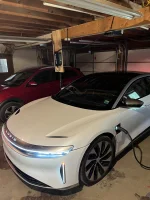
Yes, but on a drywall wall.You mean like this? Please excuse the mess. I’ve shoved my mgb project car in there too. The charger cable currently hangs over but can easily reach outside. Downside is that darned pole in the middle of the floor.
Actually considering putting the charger higher to stay out of folks faces when they get out of the car.
And for the record, that’s not much mess… the other stall in my garage has my MB 380sl, along with about 2,000 bf of rough cut lumber being stored against the far wall. That’s just part of my mess. I have a “working” garage as they say.
And for the record yes my wife has dibs on the garage whenever the weather looks to be crappy

- Joined
- Oct 5, 2026
- Messages
- 1
- Reaction score
- 0
- Cars
- 2026 Lucid Gravity GT
My Emporia is mounted about five feet above the floor, mid garage, and the included holster is mounted near the rear of the garage. This works well for me. Another thought: if you will always be charging outdoors, you could mount the Emporia outside instead, as it is rated for that. If you are concerned about theft of electricity you could install an inline switch in the garage. Not sure if using the breaker for that purpose is acceptable.
Thanks. No concern about theft of electricity- really just wanted outside access if needed for a friend or if it was raining/snowing and my wife’s car was in the garage.My Emporia is mounted about five feet above the floor, mid garage, and the included holster is mounted near the rear of the garage. This works well for me. Another thought: if you will always be charging outdoors, you could mount the Emporia outside instead, as it is rated for that. If you are concerned about theft of electricity you could install an inline switch in the garage. Not sure if using the breaker for that purpose is acceptable.
Great to hear no issues w a five foot mount height.