
Lucid Mobile Charger on NEMA 14-50 Charging Speed

HammerOfDawn

New Member

Joined
Jun 18, 2026
Messages
11
Reaction score
10
Cars
Gravity GT
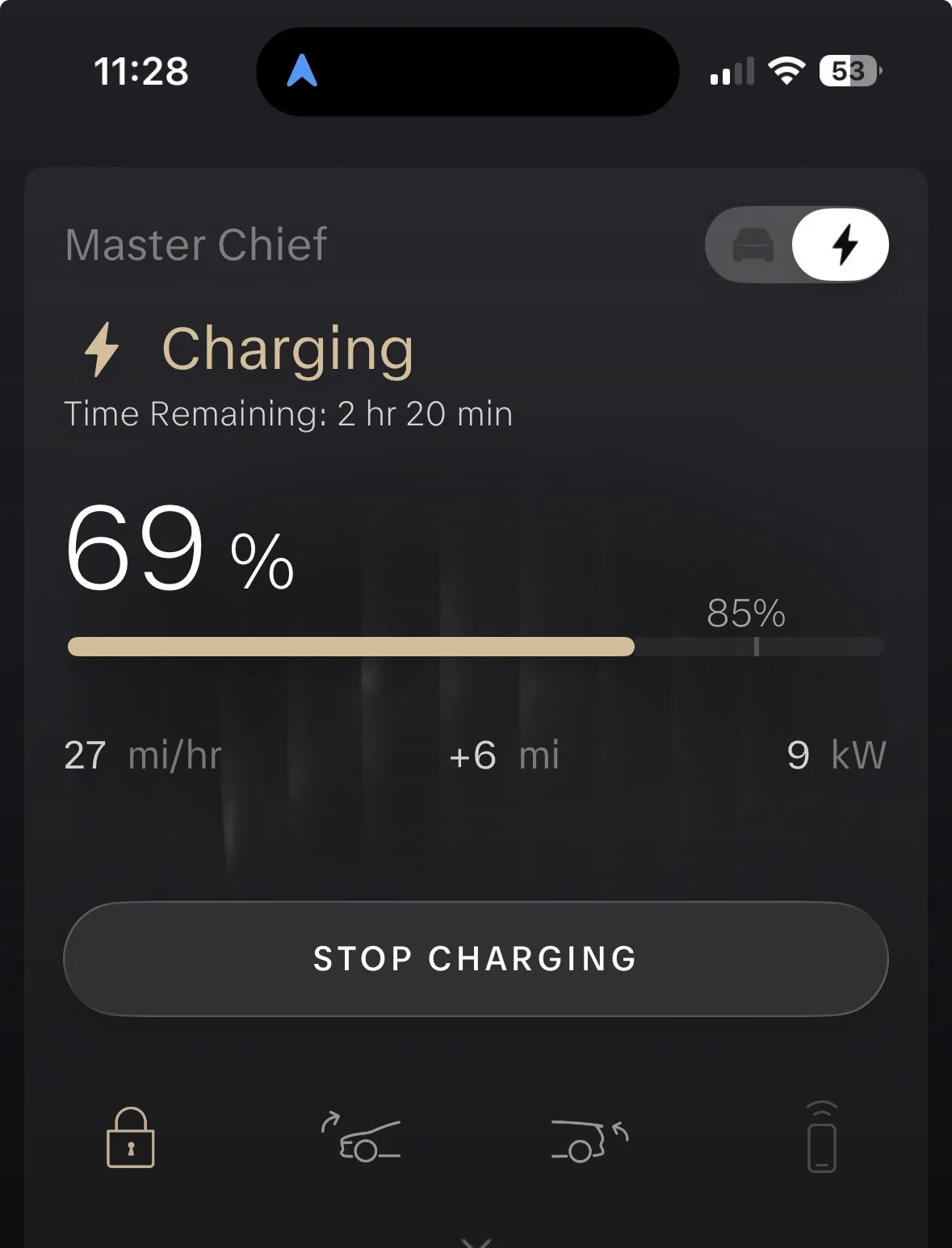
Lucid’s website states that the mobile charger can add up to 40 miles of range per hour on a NEMA 14-50 plug. However I am only getting 27 to 28 miles an hour of range added. The car is set for 40 amps max charge rate, is this normal? I understand the “up to” part, but this seems like I am not getting all the juice I should be getting.
IMG_1356.webp
 
The miles gained are based on dynamic range I believe, so the mi/hr may vary, but the kw should be consistent. I'm not 100% sure on this, but that's been my observation
 
[…] However I am only getting 27 to 28 miles an hour of range added. The car is set for 40 amps max charge rate, is this normal? […]
Yes, this is perfectly normal. Your charge rate is 9 kW, with 9.6 kW being the maximum at 40 A (40 A x 240 V). The display isn’t show fractions.

The miles per hour is based on your dynamic efficiency and how you drive. If you get 3 miles/kWh vs. 4 miles/kWh, you’ll be gaining 29 miles/hr vs. 38 miles/hr for the same 40 A charge rate.

The ICE equivalent is like pumping gas at 10 gallons per minute. In a 20 MPG car, you’ll be getting 200 miles/minute vs. a 30 MPG car where you’re gaining 300 miles/minute.

In case it helps:
  • A (amps) and kW (kilowatt): flow rate, like gallons/second or liters/second.
  • kWh (kilowatt-hour): total quantity, like gallons or liters.
 
Last edited:
Yes, this is perfectly normal. Your charge rate is 9 kW, with 9.6 kW being the maximum at 40 A (40 A x 240 V). The display isn’t show fractions.

The miles per hour is based on your dynamic efficiency and how you drive. If you get 3 miles/kWh vs. 4 miles/kWh, you’ll be gaining 29 miles/hr vs. 38 miles/hr for the same 40 A charge rate.

The ICE equivalent is like pumping gas at 10 gallons per minute. In a 20 MPG car, you’ll be getting 200 miles/minute vs. a 30 MPG car where you’re gaining 300 miles/minute.

In case it helps:
  • A (amps) and kW (kilowatt): flow rate, like gallons/second or liters/second.
  • kWh (kilowatt-hour): total quantity, like gallons or liters.
This is incredibly helpful, thank you!!
 
Yes, this is perfectly normal. Your charge rate is 9 kW, with 9.6 kW being the maximum at 40 A (40 A x 240 V). The display isn’t show fractions.

The miles per hour is based on your dynamic efficiency and how you drive. If you get 3 miles/kWh vs. 4 miles/kWh, you’ll be gaining 29 miles/hr vs. 38 miles/hr for the same 40 A charge rate.

The ICE equivalent is like pumping gas at 10 gallons per minute. In a 20 MPG car, you’ll be getting 200 miles/minute vs. a 30 MPG car where you’re gaining 300 miles/minute.

In case it helps:
  • A (amps) and kW (kilowatt): flow rate, like gallons/second or liters/second.
  • kWh (kilowatt-hour): total quantity, like gallons or liters.
To be more clear, because home voltages vary anywhere from 220v-240v (and that’s only on average), the rate can be anywhere from 8800 W - 9600 W, or 8.8-9.6kW
 
Or even down to 8kW on 40A if you have 208V service and some sag, like I did at my old home and at work
 
The charger that I think is the mobile charger that comes in the little bag with a normal 110 plug is all that I see besides the CCS1 and J adapters in my car. Is there some other plug that I should have or should be buying to be able to plug the mobile charger into a NEMA 14-50 outlet?
 
The charger that I think is the mobile charger that comes in the little bag with a normal 110 plug is all that I see besides the CCS1 and J adapters in my car. Is there some other plug that I should have or should be buying to be able to plug the mobile charger into a NEMA 14-50 outlet?
It should have come with a 14-50 plug as well.
 
It should have come with a 14-50 plug as well.
Thank you, I found it.

On a separate note, if I can use a 14-50 plug to charge my Gravity, what's the benefit of installing the LCHC?
 
No, the charger you get
Thank you, I found it.

On a separate note, if I can use a 14-50 plug to charge my Gravity, what's the benefit of installing the LCHC?
If you put a 100A circuit behind the LCHC then you can charge at 19.2KW instead of 9.6KW. If you already have a NEMA 14-50 receptical I would just use the NEMA 14-50. If you are starting from scratch I'd get the LCHC and put a 100A circuit behind it.
 
On a separate note, if I can use a 14-50 plug to charge my Gravity, what's the benefit of installing the LCHC?
Right now, mainly faster charging.
Also, note that 14-50 receptacles designed for clothes dryers may overheat and catch fire if used for EV charging. EV-rated 14-50 receptacles with an EV logo on the front should be fine.
 
No, the charger you get

If you put a 100A circuit behind the LCHC then you can charge at 19.2KW instead of 9.6KW. If you already have a NEMA 14-50 receptical I would just use the NEMA 14-50. If you are starting from scratch I'd get the LCHC and put a 100A circuit behind it.
I unplugged my welder and ran the portable for most of a year then hardwired a permanent 80A charger LCHC
 
FWIW, beyond just charging faster, technically there is a slight efficiency win, as the less time you spend charging the less time all vehicle systems related to charging need to be powered on.
 
Really great information here. Thank you, everyone.
 
I had an electrician check the un-used dryer outlet in my garage before I tried EV charging; glad I did as it was invisibly cracked & had a loose wire. Cost me $150 for a new receptacle and works fine - but it is 14-30, on a 30 amp breaker, so I bought the Lucid 14-30 pigtail and set the car to pull 24a.

I generally plug in when I'm around 25 - 30% and limit the charge to 85%, which typically takes 10-12 hrs. I'm on time-of-day pricing with PG&E so I set the charge to begin 12:05am when the cost is lowest, $0.33 / kWh.

That's fast enough for my needs. Only reason I could see buying the Lucid charger would be if I wanted to power the house with the Gravity during an extended outage. As it is, I could buddy-breathe the freezer in the garage + the 'fridge in the kitchen with the car's power outlets.
 
Back
Top