
Im not a computer guy but doesn't Tesla need more "tops" to read photo images and process them than a Lucid or any other car with Lidar. Seems like Tesla needs to think more to figure out what is happening since it does not have Lidar as solid confirmation of proximity and other parameters needed to make decisions.Cosmos/Earth/Unnamed midsize models has been announced to be using 2x Nvidia Thor that can each do 1,000 TOPS. Nvidia doesn't make it clear if doubling the chips is a straight multiplication or if there's some minor loss due to the need to transfer data between each individual chip. (Anyone remember SLI?)
Comparisons:
Consumer spec Gravities use 2x Nvidia Orin chips, each with 264 TOPS (trillions of operations per second, aka how powerful the chips are). No idea what the Nuro/Uber versions run but they've made it clear it's more powerful.
Tesla HW4 (current gen) can do 720 TOPS and HW5 is expected to do 2,000 - 2,500 TOPS. Rivian's Autonomy hardware coming to later versions (with LIDAR) of the R2 will do 1,600 TOPS. But initial versions of the R2 will only have 200 TOPS.
This is why Lucid didn't mention the Gravity getting L3/4 autonomy and why the R2 needs that new hardware coming later this year.
Volvo EX60 is using one Nvidia Orin
BMW iX3 is using some version of Snapdragon Drive which can have 200-700 TOPS
If you're looking for some kind of point to point self driving (monitored or not), and you use Tesla HW4 as the baseline compute requirement, then it's pretty clear what cars will be able to, eventually, do it.
You are using an out of date browser. It may not display this or other websites correctly.
You should upgrade or use an alternative browser.
You should upgrade or use an alternative browser.
Lucid Cosmos Specifications
- Thread starter patriots328
- Start date

- Joined
- Jun 22, 2024
- Messages
- 1,545
- Reaction score
- 1,295
- Location
- Naperville, IL
- Cars
- 14 CR-V EXL, 26GravityGT
- Referral Code
- W772ZCOT
Right and going to 924V saves way more money and weight on the size of drivetrain and other components in thermals to handle less current than 48V aux systems. Even if the main components running at 924V are more expensive. 400V is a pretty standard commercial/small industrial voltage for lots of component switchgear and motors like air compressors for HVAC or suspension.I would be extremely surprised if they go 48V. The benefits are there (mostly thinner wires / smaller wiring harnesses, which also means weight), but finding off the shelf components at 48V will be a nightmare, as it’s niche and nearly all vehicles run on 12v.
Cybertruck is the exception, but 48v didn’t save it lol.
Given Lucid already has issues with supply chain and finding consistent components sometimes, I think that’d be a mistake.
- Joined
- May 19, 2025
- Messages
- 502
- Reaction score
- 645
- Cars
- BMW X1
I thought Lucid confirmed during their investor day that midsize is on 800VRight and going to 924V saves way more money and weight on the size of drivetrain and other components in thermals to handle less current than 48V aux systems. Even if the main components running at 924V are more expensive. 400V is a pretty standard commercial/small industrial voltage for lots of component switchgear and motors like air compressors for HVAC or suspension.
- Joined
- Jun 22, 2024
- Messages
- 1,545
- Reaction score
- 1,295
- Location
- Naperville, IL
- Cars
- 14 CR-V EXL, 26GravityGT
- Referral Code
- W772ZCOT
800V is just a 'class' category of voltage. Reality with its battery size it will probably 724V like the Air Pure or Touring. Only the GT and Sapphire run 924V with the big packs. But the previous post commentary is about aux systems that run sensors, computers, seats etc. Not the main drivetrain.I thought Lucid confirmed during their investor day that midsize is on 800V
I hope you are wrong on this. R2's "330" mile range is just not good enough for winter climates. That is for road tires. . . Replace with all terrain and you are down to 307 miles. Now factor in highway speeds, which is the only speed that matters for real world range and you are well under 300 miles. Now add winter conditions and you may be lucky to break 200 miles, particularly if hauling a family. In my own opinion, that is just not enough to be a reliable road trip vehicle, and this is not the vehicle category in which it is an "extra" vehicle, it has to be a workhorse. Lets hope Cosmos shoots for a brand consistent 400 miles or so.300-330 range is the standard for the mid-size category and many do not even reach that (Ioniq 5 and Toyota, etc)
- Joined
- Jun 22, 2024
- Messages
- 1,545
- Reaction score
- 1,295
- Location
- Naperville, IL
- Cars
- 14 CR-V EXL, 26GravityGT
- Referral Code
- W772ZCOT
It shouldn't be hard to beat R2, both SOC and OOS have tested it and its pretty mid on range and terrible efficiency (like Gravity Touring level for much smaller car). Worse than the Model Y, which means way worse than Cosmos, EX60 or BMW IX. Although the EX60 EPA ratings for the small pack are also only 330 miles.
R
R2 is a minime of R1S. Lazy designing and not great at EV tech vs competition. Software can be improved, hardware can’t. And they still use 400V architecture. Poor aerodynamics.I hope you are wrong on this. R2's "330" mile range is just not good enough for winter climates. That is for road tires. . . Replace with all terrain and you are down to 307 miles. Now factor in highway speeds, which is the only speed that matters for real world range and you are well under 300 miles. Now add winter conditions and you may be lucky to break 200 miles, particularly if hauling a family. In my own opinion, that is just not enough to be a reliable road trip vehicle, and this is not the vehicle category in which it is an "extra" vehicle, it has to be a workhorse. Let’s hope Cosmos shoots for a brand consistent 400 miles or so.
- Joined
- Jan 3, 2022
- Messages
- 7,492
- Reaction score
- 8,549
- Location
- San Francisco Bay Area
- Cars
- Gravity GT, XC40 P8 EV
- Referral Code
- 3OKY7YGA
And they'll sell a ton of them. Three friends have ordered an R2 already, out of the four I knew who were looking for a new vehicle.R2 is a minime of R1S. Lazy designing and not great at EV tech vs competition. Software can be improved, hardware can’t. And they still use 400V architecture. Poor aerodynamics.
It's a capable-looking SUV at a reasonable price from a company with a great brand identity, and not a Tesla.
- Joined
- Apr 15, 2025
- Messages
- 910
- Reaction score
- 1,632
- Cars
- GGT, Merc E450 Conv
I highly doubt that Cosmos will be anywhere near 400 mile range. It would cost too much. They are more interested in competing with Model Y and R2 and so they need to keep price in the sub $60K range and have mileage in similar range (maybe slight improvement) as those cars and counter with better charging. Unlike the “compromise nothing” mantra, if you are trying to build toward a reasonable price target, you have to compromise some things.Yup, under 350 miles generally will not work for me in the winter. If there isn't a 400+ mile version I'm going to either stick with Air/Gravity or look elsewhere.
Yes, but Lucid needs to have something that makes the Cosmos a special car. With the Gravity it was room, HP and range. The Cosmos needs to be best at one of those things because it cannot ride on the reputation of Lucid because there is none or it is negative. To my point, we were reporting an accident and the person at AAA had never heard of the manufacture Lucid. This is in SF bay area 40 miles from Lucid headquarters! So the Cosmos needs to be unique and stand out in some way, or it is doomed in the US market. In most comparisons done by auto publications Lucid vehicles are not included. Im not sure how to change this, but the PR, advertising department needs to do a lot better. Maybe some crazy new colors could help too. People pay attention to flashy objects! Lucid needs some flashy.
- Joined
- Oct 29, 2024
- Messages
- 27
- Reaction score
- 43
Based on their investor day presentation deck, Cosmos would need approx 92-93 KWh battery pack to hit 400 mile EPA range (@ 4.35 mi/KWh). This size would be in-line with Mercedes GLC (92kwh approx) and Rivian R2 (88kwh approx) and superior to BMW iX3 (112kwh US spec) and Volvo EX60 (P12 117kwh and P10 92 kWh).I highly doubt that Cosmos will be anywhere near 400 mile range. It would cost too much. They are more interested in competing with Model Y and R2 and so they need to keep price in the sub $60K range and have mileage in similar range (maybe slight improvement) as those cars and counter with better charging. Unlike the “compromise nothing” mantra, if you are trying to build toward a reasonable price target, you have to compromise some things.
They did indicate that Cosmos is going to be a 800v battery pack, which seems to suggest that one of the configuration/trim will have large capacity. I suspect they will follow the Air/Gravity pricing strategy with different battery pack sizes for different trims. A Cosmos GT with roughly 90KWh and lower trims with 80 kWh or lower size pack to compete with Tesla is a possible scenario.
This should give them ability compete with models with large battery pack like BMW iX3 and Volvo EX60 P12 at a better price point due to the smaller battery comparatively. And at lower end compete with Tesla Y and Rivian R2 with smaller battery effectively covering 2 ends of spectrum in the midsize market.
Also, they have indicated that the RWD config has much higher efficiency that the AWD for Cosmos. This gives them the flexibility to go really compact battery for RWD to match Model Y RWD or have vastly superior range with same battery size as the lower trim Cosmos AWD (touring) to keep manufacturing complexity simple.
All speculation but their investor day presentation suggests that they have the tech to compete with Tesla on price at scale and outdo Rivian R2 on range (which isn’t that impressive in 2026 based on 70mph range test by Tom and 10% challenge by OoS).
This is, without a doubt, the correct approach for them to take. There are a lot of people willing to pay more for range. It'd be a mistake if they didn't offer a high end/long range package.I suspect they will follow the Air/Gravity pricing strategy with different battery pack sizes for different trims. A Cosmos GT with roughly 90KWh and lower trims with 80 kWh or lower size pack to compete with Tesla is a possible scenario.
This should give them ability compete with models with large battery pack like BMW iX3 and Volvo EX60 P12 at a better price point due to the smaller battery comparatively. And at lower end compete with Tesla Y and Rivian R2 with smaller battery effectively covering 2 ends of spectrum in the midsize market.
I know this is meant to be a mass-market vehicle, but I'm hoping they allow for premium options for those that want them. It's one of my annoyances with car manufacturers generally. I don't get why everyone's full-size sedan/SUV have to be the only vehicles that can be specced with flagship options (e.g. best speakers, best suspension, most extensive leather, best engine/motor, etc.).
- Joined
- Dec 5, 2023
- Messages
- 156
- Reaction score
- 238
I agree here. Lucid needs to stand out as the efficiency leader in the mid-size category. I'm sure many would pay $60-65k for a 400+ mile fully optioned Cosmos while others are okay with a 300 mile "pure" version at $45k. Unfortunately, Lucid at this point needs to take it on the chin by accepting smaller margins in order to build sales volume then once Lucid is widely established brand doing 50k+ vehicles a year they can raise prices as needed. Assuming the software is up to par as well, the product will be a home run.This is, without a doubt, the correct approach for them to take. There are a lot of people willing to pay more for range. It'd be a mistake if they didn't offer a high end/long range package.
- Joined
- May 19, 2025
- Messages
- 502
- Reaction score
- 645
- Cars
- BMW X1
Which publications said that? I don't recall reading that beforeThe earlier press said the two wheel drive was to be front not rear. Not sure this has changed. I was of the opinion it should be rwd, but have come over to fwd as a base model.
- Joined
- Oct 29, 2024
- Messages
- 27
- Reaction score
- 43
According the attached slide from investor day deck, the single axle version would be RWD. Based on this, I would think the AWD would be rear wheel biased.The earlier press said the two wheel drive was to be front not rear. Not sure this has changed. I was of the opinion it should be rwd, but have come over to fwd as a base model.
Attachments
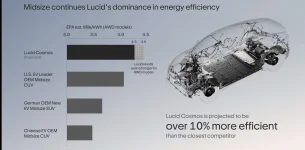
Considering what Lucid advertises about the Gravity and what it does in the real world, I would take their claims about the efficiency of the Cosmos with a grain of salt. Just like how the CEO of Rivian (possibly) said the R2 would be able to match the efficiency of the Model Y, which is clearly not true based on initial testing, these executives all want to advertise that they can beat the class leader/best seller.
Lucid should not be using the 5-cycle EPA test. Or they should not use such a low adjustment factor so they can advertise a higher range. One of the last things this company needs are early adopters of the Cosmos going around and saying their 380 mile EV (or whatever it actually ends up being) can only get 320 or 330. If one of the pillars of your company's advertising is efficiency/range then the last thing you want are your customers saying about your mass market model is that the range sucks or it can't actually hit the range you advertise even if the actual efficiency ends up being better than the Model Y.
But, these objective measurements don't matter to a lot of people. Buying cars has been and will be an emotional purchase for so many. This is why people buy "objectively worse" cars all the time. Lucid better have a good story to tell about the Cosmos when it's finally revealed.
Lucid should not be using the 5-cycle EPA test. Or they should not use such a low adjustment factor so they can advertise a higher range. One of the last things this company needs are early adopters of the Cosmos going around and saying their 380 mile EV (or whatever it actually ends up being) can only get 320 or 330. If one of the pillars of your company's advertising is efficiency/range then the last thing you want are your customers saying about your mass market model is that the range sucks or it can't actually hit the range you advertise even if the actual efficiency ends up being better than the Model Y.
But, these objective measurements don't matter to a lot of people. Buying cars has been and will be an emotional purchase for so many. This is why people buy "objectively worse" cars all the time. Lucid better have a good story to tell about the Cosmos when it's finally revealed.
- Joined
- Nov 9, 2025
- Messages
- 823
- Reaction score
- 1,276
- Cars
- Model X, XC90, S4, LS460
- Air DE Number
- 1
- Gravity DE Number
- 160
- Referral Code
- 34DTL9L0
This has been covered in other threads. The 5-cycle test was developed by the EPA to replace the “inaccurate” 2-cycle test, and there is no discretionary adjustment factor that Lucid (or any other car manufacturer) applies.[…] Lucid should not be using the 5-cycle EPA test. Or they should not use such a low adjustment factor so they can advertise a higher range. […]
We can achieve the EPA rating if we drive like the test conditions, as has been posted by some Gravity owners. The problem is, none of us are interested in range under the 5-cycle test scenario.
Lobby congress/EPA for a pure 70 mph range test.
Last edited:
- Joined
- Oct 22, 2020
- Messages
- 897
- Reaction score
- 799
- Cars
- 2018 Porsche Panamera Tur
Not sure I agree with what you stated, at least in the real world. My AGT gets significantly less than the 469 mile range that is advertised. Whereas my wife's BMW i4M50 gets within 5% or less than its advertised range of 269. I'm not at all concerned about my AGT's range because it gets me where I want to go and the range is sufficient for my needs. But it does irk a lot of people when the real world range comes in considerably less than the advertised range. And yes, I'm quite aware range depends on numerous factors such as driving conditions, weather, etc..But even when I drive my wife's car(and I have a heavy foot) it still comes a lot closer to the advertised range than my AGT. It would be better if Lucid gave a lower range(closer to what one would expect) than a possible but higher unlikely range(if you hypermile). Advertising the latter is a surefire way to undermine Lucid's reputation for the average consumer.This has been covered in other threads. The 5-cycle test was developed by the EPA to replace the “inaccurate” 2-cycle test, and there is no discretionary adjustment factor that Lucid (or any other car manufacturer) applies.
We can achieve the EPA rating if we drive like the test conditions, as has been posted by some Gravity owners. The problem is, none of us are interested in range under the 5-cycle test scenario.
Lobby congress/EPA for a pure 70 mph range test.