Gravity efficiency is low for me

Sort of. If you have regen OFF, yes, you'll never get close because you're only using friction brakes to slow down and not recapturing any energy. Unlike most EVs, Lucid chose not to apply regen with the brake pedal.

But 1PD (HOLD vs CREEP) and HIGH vs STANDARD regen should make almost no difference. HIGH regen won't recapture more energy than STANDARD, it should nearly always recapture the same amount. The only way it would capture more energy is if you max out regen and have to start adding friction braking to it. But that would be a really harsh stop. Normally both regen settings (since STANDARD is already very strong itself) offer more than enough regen slowing for normal driving. They're rarely ever max'd out to the point of having to add friction brakes.

Until you get down to below 5 MPH to do the final stop, that is. Friction brakes are always needed to do the last few MPH and final stop. Even in 1PD (the car just does it for you automatically). So there really shouldn't be any difference in energy recapture, except for the rare times you have to do a really hard slowdown beyond the max of the already-strong STANDARD regen. .

That's my understanding of how it works, anyway.
Wait...don't you use the friction brakes more with Regen on Standard than on High when coasting to a stop?? The physics don't seem to add up unless I'm not considering something here. 🤷‍♂️

I go weeks without touching the friction brakes because you can slow down so precisely letting up on the accelerator in the High Regen setting (1PD) that you can even often keep the vehicle in motion at 1 or 2mph at most stoplights before accelerating again when the light changes just like putting a stick shift in neutral and coasting slow with the brake. It conserves momentum. And if it's a longer light and you do need to actually stop Hold keeps the car from rolling if your momentum ceases so the friction brake just isn't needed; therefore, less wasted energy to heat escaping them. What am I missing here??
 
Wait...don't you use the friction brakes more with Regen on Standard than on High when coasting to a stop?? The physics don't seem to add up unless I'm not considering something here. 🤷‍♂️

I go weeks without touching the friction brakes because you can slow down so precisely letting up on the accelerator in the High Regen setting (1PD) that you can even often keep the vehicle in motion at 1 or 2mph at most stoplights before accelerating again when the light changes just like putting a stick shift in neutral and coasting slow with the brake. It conserves momentum. And if it's a longer light and you do need to actually stop Hold keeps the car from rolling if your momentum ceases so the friction brake just isn't needed; therefore, less wasted energy to heat escaping them. What am I missing here??
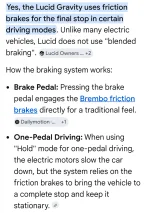
Same for me, but I am pretty sure Lucid stops to 0 without friction brakes, there is a service brake for HOLD that keeps it from moving on hills once you hit zero. I don't use creep so I don't know how it stops without a foot on the brake pedal...

Standard just targets a lower deceleration rate, so you will need to let off the accelerator earlier to come to a full stop if you don't want to use friction brakes. I have driven a similar cycle with high and standard and I did get lower efficiency with standard, so it might also be not capturing back as much energy in some other way. This also would take into account what you get back on hills... Smooth mode also changes standard regen levels above the other 2.
 
Wait...don't you use the friction brakes more with Regen on Standard than on High when coasting to a stop?? The physics don't seem to add up unless I'm not considering something here. 🤷‍♂️

I go weeks without touching the friction brakes because you can slow down so precisely letting up on the accelerator in the High Regen setting (1PD) that you can even often keep the vehicle in motion at 1 or 2mph at most stoplights before accelerating again when the light changes just like putting a stick shift in neutral and coasting slow with the brake. It conserves momentum. And if it's a longer light and you do need to actually stop Hold keeps the car from rolling if your momentum ceases so the friction brake just isn't needed; therefore, less wasted energy to heat escaping them. What am I missing here??
From what I can discern, 1PD (HOLD) uses friction brakes for that last few MPH, just like we do manually in 2PD (CREEP). Maybe it gets the timing a little more perfect than we do in CREEP but for the most part it's the same thing.

As far as HIGH regen vs STANDARD, I assume that only changes the max amount of regen deceleration within the same range (down to the last few MPH where friction brakes do the last little bit).

I could be wrong on all this, but that's been my understanding.

In CREEP and STANDARD, I slow to like 3-5 MPH before touching the friction brakes too. Sometimes I don't even hit the pedal and just do a rolling stop because it comes to almost a stop with regen.
 

Attachments

  • Screenshot_20260706-072324.webp
    Screenshot_20260706-072324.webp
    107.4 KB · Views: 46
Last edited:
Standard just targets a lower deceleration rate, so you will need to let off the accelerator earlier to come to a full stop if you don't want to use friction brakes. I have driven a similar cycle with high and standard and I did get lower efficiency with standard, so it might also be not capturing back as much energy in some other way. This also would take into account what you get back on hills... Smooth mode also changes standard regen levels above the other 2.
Unless you touch the friction brakes, it doesn't seem like it would be any more or less efficient whether you slow down from 70 to 5 MPH in 10 seconds or 15 seconds.
 
Unless you touch the friction brakes, it doesn't seem like it would be any more or less efficient whether you slow down from 70 to 5 MPH in 10 seconds or 15 seconds.
Apparently, it's not that simple, as lower voltage (lower regen) is less efficient on certain parts of the deceleration curve, its very minor, but it seems there is more heat generated in the invertor. Apparently the most effective is ramping smoothly to full regen, and then ramping down smoothly to a stop. Although I just use ACC in city a lot so it does this all for me.
 
Our subcompact XC40 EV achieved just under 2.5 miles / kWh today on a 50 mile, 70-75mph freeway drive.
Our Gravity would have used 20% less energy on the same trip. I wish I'd taken it instead.
 
Apparently, it's not that simple, as lower voltage (lower regen) is less efficient on certain parts of the deceleration curve, its very minor, but it seems there is more heat generated in the invertor. Apparently the most effective is ramping smoothly to full regen, and then ramping down smoothly to a stop. Although I just use ACC in city a lot so it does this all for me.
If that's the case, it would suggest that STANDARD is slightly more efficient than HIGH.
 
Basically you want the car to coast as much as possible instead of using regenerative braking, to minimize roundtrip losses to the battery and back. And if you regenerate, you want to decelerate as slowly as possible (but without using the friction brakes) to minimize the current passing through the motor, inverter, wiring, battery, and the related losses. If the standard regen helps you to do this, then it will be better for efficiency.

But I'd rather have a lot of regen available to maximize my control of the car without having to move my foot much. I'm that lazy.
 
Just wrapped up our first (of many) long road trips in the Gravity. 2722 miles through CO/UT/NV/WY. Basically the loop from Denver to Vegas to Reno and back to Denver. Lots of 75 and 80 MPH speed limits on I-70, I-80, and I-15.

Trip meter shows 2722 miles, 946.3 kWh, 2.87 MPK. 20/21" wheels, no 3rd row (450 EPA trim). Weather was ideal. Longest drive leg was 275 miles (twice) which we did comfortably from 100% (first leg from home, another from a hotel charge). In fact for the whole trip we only had to do 8 DCFC charges (plus 2 home/hotel charges to 100%). In our Macan that probably would have taken 12 DCFC stops, and 15 in our previous Mach-E. This is why we bought the Gravity, for the super long range. We drive this same basic route half a dozen times each year. Many of the chargers are this route are 100 miles apart and we used to have to stop at each, but now we can skip every other and go 200 miles without having to DCFC past 80% and still arrive around a comfortable 20%.

Charging was great too. 3 Ionna stops and 5 EA stops. Only had one charge fault at an EA station that I had to start over. Otherwise no problems at all. All the EA chargers hit 360+ kW (except one that I started from a higher SOC, and it still hit 326 kW). Ionna went straight to 390+ all 3 times.

Only charging problem was using Tesla destination chargers. As I posted in another thread last week, I didn't realize it wouldn't work on the older (but very common) Tesla destination chargers (the ones without the built-in adapter). I'll bring my old TeslaTap adapter next time to see if that fools it like it does for the Macan and did for the Mach-E.
 
...As I posted in another thread last week, I didn't realize it wouldn't work on the older (but very common) Tesla destination chargers (the ones without the built-in adapter). I'll bring my old TeslaTap adapter next time to see if that fools it like it does for the Macan and did for the Mach-E.
Stacking adapters is worth a try. I'll do the same on our next road trip.
It's possible that the Hyundai and Mach-e that were able to charge successfully on a few destination chargers that stymied me were using a TeslaTap.
 
Is anyone going to "N", to coast their Gravity??
 
Is anyone going to "N", to coast their Gravity??
Sounds dangerous. An easier way is to map the steering wheel custom button to regen levels. When you want to coast, use the button to turn off regen. You can quickly press the button again when you want to slow down via regen.
 
All the EA chargers hit 360+ kW (except one that I started from a higher SOC, and it still hit 326 kW). Ionna went straight to 390+ all 3 times.
Is that how fast the Gravity normally charges? Wow!
 
Is that how fast the Gravity normally charges? Wow!
Yes, at low SOC. Pretty awesome charging curve for road trips.
 
@borski are there any IONNA chargers in the bay area besides the one in San Francisco (that are actually up and working)?
Yes! I just used one in San Jose with the Air the other day. There are two in SJ now, and a third opening. There is also one in SF as you mentioned, and one in Daly City. A Pacifica one is opening soon too. And one in Larkspur if you like north bay! :)
 
Is that how fast the Gravity normally charges? Wow!
400kw, actually, at low SOC (like under around 20%). ~366 is just as much as the EA 350s will put out (when all is working well). The Ionnas can hit 400.

Doesn't stay there very long. It tapers down from there. But it starts fast and still does well overall. Here's a pic from one of my Ionna chargers last week. I should have taken the whole screen, but looks like I got 73.5 kw in 19 minutes. Really good. And consistent.

PXL_20260709_181649739.webp
 
Last edited:
@borski are there any IONNA chargers in the bay area besides the one in San Francisco (that are actually up and working)?
Like EA and Tesla, their website has a good map. You can filter Coming Soon off if you just wanna see currently open ones.

I save the map page as an icon to my phone.

 
Back
Top