Below is a summary of our recent Gravity trip from Phoenix to Yellowstone to St George to Zion and back to Phoenix. I will do three posts, one for the drive to Yellowstone, one for getting around Yellowstone and one for the return trip to Phoenix.
Drive to Yellowstone
We decided to overnight in Ogden a the way to Yellowstone. The route was Phoenix, Flagstaff AZ, Page AZ, Kanab UT, Beaver UT and Ogden Utah. The weather went from sunny and 95 degrees to rain and 50 degrees with significant headwinds.
Phoenix to Flagstaff
The drive from Phoenix to Flagstaff has 6500 feet of elevation gain, the winds and temperature were ideal. We left home with 95% SOC and navigation predicting 40% SOC at EA in Flagstaff. We arrived with 38% SOC and dynamic efficiency showing 2.64 m/kWhr. Since the weather was ideal with little wind, I attribute the 2% discrepancy to a week’s worth of added weight for beverages, food and luggage. Charging at EA in Flagstaff was good. Gravity pulled 173kW at 38% and still taking 121kW at 80% SOC. I do not remember the charging time, but it was enough for restroom, refilling drinks, tossing some trash and a refreshing 5 minute walk.
Flagstaff to Page
We chose to charge at Circle K in Page rather than Kanab because the Kanab chargers had a very poor Plugshare rating. Plugshare showed two of four chargers (each charger has two ports with load sharing) in Page not working so we took on enough electrons in Flagstaff to easily make Kanab if needed. Navigation predicted 50% SOC at Page which was spot on when we arrived in Page. Dynamic efficiency was 3.00 mi/kWhr. Two of the four chargers were indeed not working with one car at each good charger. Both cars were in the parking slot that would work for the Gravity charge port so I had to park crosswise blocking the broken charger. Gravity again pulled 175kW at 50% SOC. I charged enough so that navigation predicted 22% SOC at Beaver UT. Not a bad charging stop but I can’t wait until Ionna takes over this Circle K site and better maintains the chargers. Below is Glen Canyon dam and lake Powell. Notice the waterline after a few years of drought.
Page to Beaver
Since we had never used an Ionna charger, we chose the Ionna network in Beaver. The weather got much worse between Page and Beaver with the temperature dropping, winds picking up and some rain. We arrived at Ionna with 17% SOC, 5% less than navigation predicted. The dynamic efficiency was 2.92 mi/kWhr. I attribute the discrepancy between predicted and actual SOC to the weather, especially headwinds. Gravity pulled 388kW at 17% SOC using the native NACS Ionna connector. This was our first DC charge without an adapter, I am now sold on how much better the NACS connector is relative to CCS. Ionna needs to add some shades to this site. It is a great site for anyone on I-15.
Page to Ogden
We left Beaver with navigation showing 12% SOC on arrival to our Ogden hotel. The headwinds turned to tailwinds with off and on rain. My wife took over the driving on I-15 and drove much more “efficiently" than I would. The Utah interstate speed limits are 80 mph so I would have driven 85 but my wife slowed down to about 75 mph. We arrived at the hotel with 30% SOC and a dynamic efficiency of 3.2 m/kWhr. I attribute the SOC discrepancy to slower speed and tailwinds. I was surprised by the 12% difference given the predictions earlier in the day were overestimating SOC on arrival.
We charged the following morning at EA Union Station in Ogden. The charger was 2 blocks from our hotel. Gravity pulled 229 kW at 30% SOC with no preconditioning. The temperature was in the low 40’s. This seems like a great charge rate for no preconditioning. I like this EAS site, especially the old train engine in the background.
Ogden to Pocatello
We left Ogden with navigation showing 30% SOC on arrival to Idaho Falls. The weather turned against us with heavy rain, headwinds, colder temperatures and elevation gain. I watched the predicted SOC at Idaho falls drop from 30% to 15%. I have 15% arrival SOC set as the minimum in navigation. The route planner automatically re-routed to EA in Pocatello ID. We needed a bathroom break anyway so we liked the new plan. I believe that we could have made Idaho Falls, but temperatures in the low 30’s with rain is not the time to push range. We arrived at EA Pocatello with 37% SOC and a dynamic efficiency of 2.72 mi/kWhr. Gravity pulled 280 kW. I wanted extra electrons as we got closer to Yellowstone since charging around Yellowstone is limited. I wanted enough charge to get to Island Park chargers and then to Gardiner if Island Park did not work. There is a theme here that here that I like available backup options.
Pocatello to Island Park
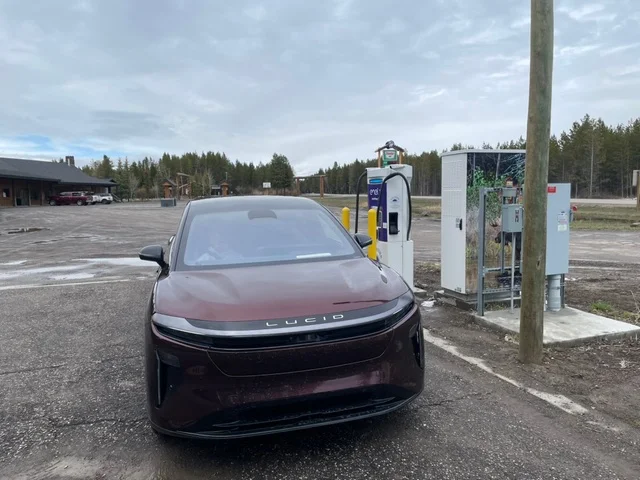
Island park has the last DC fast chargers (available to non-Tesla’s) before entering the West Yellowstone entrance to the park. We left Pocatello showing 49% SOC on arrival to Island Park. The weather continued to get colder as rain turned to snow and the headwinds picked up. We arrived at Island Park with 43% SOC and a dynamic efficiency of 2.61 mi/kWhr. The Island Park Enel Energy chargers were pretty poor to say the least. Two chargers with one completely broken. The one working charger would not take credit cards so I had preloaded the app on my phone. However, initiating a charge using the app is the most convoluted process I have seen. It took me 20 minutes to start charging. Gravity pulled 174kW at 43% SOC which was nice to see. We charged to 97% so that we would have enough charge to get around the park without having to go to Gardiner for a recharge. On the bright side, Enel Energy still has not billed me for the charge. I wish these non-mainstream charge networks would maintain their equipment.
Total charging cost for the trip from Phoenix to Yellowstone, not including Island Park, was $136.96. I am sure that my old Grand Cherokee would have cost a lot more and would not have been nearly as comfortable.