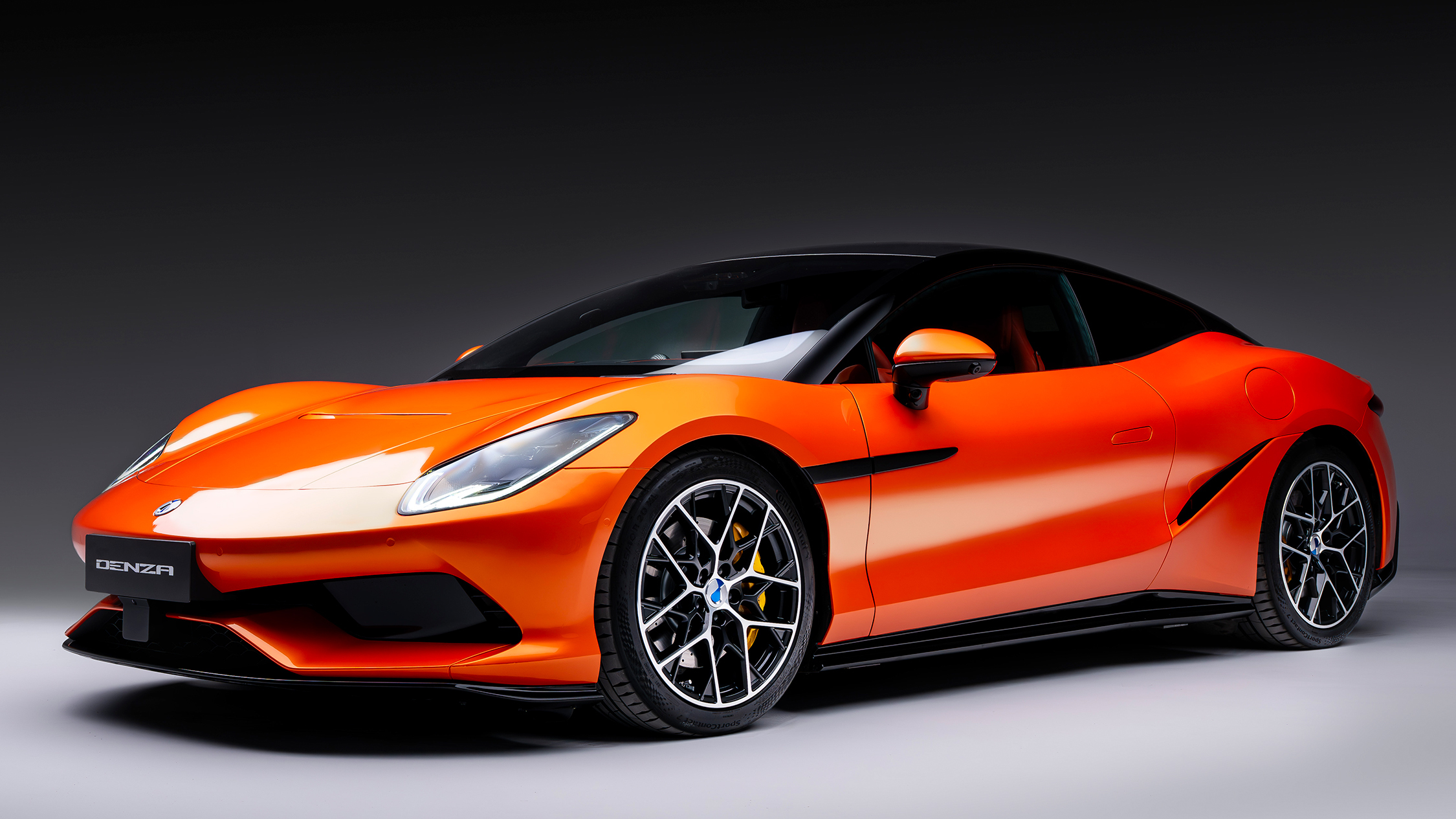
US carmakers should be terrified, including Lucid

I was blown away by these Chinese EV’s.


Lucid’s real competition is Chinese EV’s. All US car makers should be terrified. Didn’t we learn from the 1980’s when Japan dominated the global auto market? History is now repeating itself with the Chinese.
Lucid could compete it they would just deliver what they promised 4 years ago.
Lucid made a fatal error by abandoning their base of early adopters who were promised V2H, hands free driving, and advertised range that can only be achieved when going downhill with a 30mph wind at their back.
I love my touring, but Lucid deserves what they get...
Please no snowflake responses. It is too old...
 
I’m not so sure that it was speed that doomed these efforts as much as it was an inability to provide vehicles that the market had interest in. An electric F-150 is a great idea but not if it can’t tow more than 100 miles. The Hummer EV is really cool until you consider that it’s a niche vehicle, retails over $100K, and will cost more to charge than a tank of gas in an ICE car. They also focused on vehicles that appeal to ardent ICE owners (big trucks, and SUV’s). The appeal of EV’s is efficiency and/or performance.

But they’re learning. The Bolt sells quite well as does the Equinox EV. They’re competent and affordable. Ford will soon release its new EV pick-up which will more closely resemble the Maverick in pricing and capabilities. More importantly the US automakers have to compete globally. The US is lagging China and Europe in EV adoption. Those are important markets from a manufacturing and sales standpoint to GM and Ford. BYD, Geely, and NIO are doubling down on their efforts to expand in those areas in both production and sales. They're also investing heavily in global infrastructure and EV technology. Ultimately supply chains and economics pivot towards growth. And it can happen quickly. It wasn’t long ago that BlackBerry and Nokia dominated the cell phone market.
I can wax poetic about EV trucks and why they are what they are but it would be waaaay off-topic. Fascinating, but way off topic. I'll touch on it when an appropriate thread arises.
 
Yeah, great plan, let’s just build ICE and hybrids while China takes over…..present crop of CEOs in Detroit only care about the next 3-5 years. After that it will be someone else’s problem. If you don’t spend now on the tech and supply chain, you will be history in a decade, or at least confined to selling cars in just USA while rest of the world moves on to pure EVs. I see Detroit in big trouble in a decade.
I addressed most of this in post #140. Other than that I will point out that every time the question is put in front of Mary Barra she says
  1. GM is still committed to an all-electric future
  2. GM will no longer put a date stamp on when that will happen but will continue to develop product with that eventuality in mind.
 
What you say makes sense but I"m gonna totally disagree based on "insider" knowledge. From both sides of the table. When I was at GM I was in Product Portfolio Planning. Much of the reason I was able to toss out the numbers I tossed out. I dealt with them all the time. I am also aware of how forward product planning and strategy development work and what needs to be true in order to make the type of strategy pronouncements GM was making. Part of the portfolio planning process involves ingesting and analyzing incredible amounts of external data to better "predict the future". We built scenarios in windows 5 - 15 years forward. Without doubt a direction locked in on Day 1 only approximately resembled the original strategy 10 years later but how close it came was dependent on the quality of the initial analysis as well as all the factors (regulation, material availability, new emerging technologies, competitor actions) but getting the "rudder direction" locked in has always been pretty important.

The common assumption that vehicle development takes 3 years from concept to car on the road is an over-simplification. Actuality is close to 5 - 8 years. The 3 year scenario is actually starting from the pot that the OEM has decided "we need a vehicle in this segment and it needs to fit in this square / segment and we need to capacities for xxx thousand per year in this price range and they will need to compete with A, B, C, and D". Those things are wrangled out in Strategic Planning and Product Portfolio planning before a single line is drawn to paper. When GM said in 2019 that they would be 100% zero emissions by 2035 they were factoring a full 2 product life cycles of gradually wind down ICE operations. That is super-aggressive. I didn't think it would be possible (they didn't ask me ;) ) but I could see that it was aspirational (not hell or high water) and likely announced primarily to get the supply base to focus on it and take seriously the development of technologies to support.

One of the key sources for data, information, and market forecasts that we used when I was at GM was IHS Markit which was later acquired by S&P Global and recently (days ago) spun off as Mobility Global. They provided industry forecasts looking as much as 12 years forward on a detailed (Brand / Model / Powertrain spec) level. When I retired from GM I did some independent consulting, then hired on with IHS Markit just before they were acquired by S&P Global, so now I was on the other side of the table working with GM (and other OEMS and suppliers) on industry outlook and forecast.

I can say two things about the write-offs that the industry took on their directional shift from aggressive electrification plans. GM clearly was not the only automaker that was banking on a broad scale shift to EV. The fact that all these companies spent money getting their infrastructure, product development, and supply chain aligned is absolute proof that not only did they all expect the industry to make the shift, but also that they were intent on being within the leader group to get there. Why things shifted back is more a political discussion than an analysis of the markets and I'm choosing not to go there...for now. But I will say that if you look at the pace of electrification in all other key automotive markets and compare to the US, you would have to ask "what makes the US different?"

I retired from S&P Global just ahead of the recent spin off. And bought myself a really cool retirement present which is what brought me to this user forum.

That’s a lot of great knowledges and insight. It’s one thing to opine on an industry as an observer and another to have been in the trenches.

The words I hear most often around EV adoption from Mary Barra and others is “a question of when, not if.” And the question for GM and others is if they will have made the right decisions to be around when it happens.
 
[…]
The words I hear most often around EV adoption from Mary Barra and others is “a question of when, not if.” And the question for GM and others is if they will have made the right decisions to be around when it happens.
The problem is that while the US has been pulling back on EV’s, the rest of the world is going forward with EV’s. China has already put in place their supply chain, manufacturing, and technology base supplying that global market. While China is innovating, the US is waiting.
 
The problem is that while the US has been pulling back on EV’s, the rest of the world is going forward with EV’s. China has already put in place their supply chain, manufacturing, and technology base supplying that global market. While China is innovating, the US is waiting.
Agreed. Having industry and government resources aligned provides huge advantages.

I’m not sure we’re even waiting. We seem to be in full blown denial of what’s happening around us. While China innovates and invests we’re rolling back emission standards and upending the petroleum markets. We’ve introduced a level of instability that will only further help the Chinese in their efforts. And just like our other manufacturing industries we’ll wake up one day and wonder how it all happened.
 
Last edited:
I’m not so sure that it was speed that doomed these efforts as much as it was an inability to provide vehicles that the market had interest in. An electric F-150 is a great idea but not if it can’t tow more than 100 miles. The Hummer EV is really cool until you consider that it’s a niche vehicle, retails over $100K, and will cost more to charge than a tank of gas in an ICE car. They also focused on vehicles that appeal to ardent ICE owners (big trucks, and SUV’s). The appeal of EV’s is efficiency and/or performance.

But they’re learning. The Bolt sells quite well as does the Equinox EV. They’re competent and affordable. Ford will soon release its new EV pick-up which will more closely resemble the Maverick in pricing and capabilities. More importantly the US automakers have to compete globally. The US is lagging China and Europe in EV adoption. Those are important markets from a manufacturing and sales standpoint to GM and Ford. BYD, Geely, and NIO are doubling down on their efforts to expand in those areas in both production and sales. They're also investing heavily in global infrastructure and EV technology. Ultimately supply chains and economics pivot towards growth. And it can happen quickly. It wasn’t long ago that BlackBerry and Nokia dominated the cell phone market.
The cell phone analogy has always be a faulty one relating to EVs. Smartphones were a massive increase in functionality for buyers over what they had prior, so there was massive demand. Magnitudes more, to the point where the phone calling part was almost irrelevant. They became pocket-size computers (and cameras), with the 100x extra that does for people.

But an EV is still just a car, doing the same things a car always did for people. Just with different fuel and fueling dynamics (pro and con). And because EV economics are good for small commuter cars but not so good for larger vehicles (SUVs and trucks) that Americans prefer, they actually represent a net loss of function for most Americans rather than a massive gain of function like smartphones did.

Thus why we're still just at 6-7% market share after a decade.
 
But that's due to the current administration...
The drop from 8% EV market share to 6%, you mean? Yes, by ending the $7500 credit (subsidies), CAFE mandates, emissions credits (extortion), and talk of ICE bans.

But those were all artificial market manipulators. Now we're seeing the real market. I think it would be more accurate to say the 8% was artificially high because government manipulation, and the 6% is more normal.

I do agree that it will naturally begin to increase again. EVs are slowly getting better and more cost competitive. But slowly. Same with charging infrastructure. EVs will be the majority eventually. But I don't think "eventually" is near term like many predict. (And have been predicting since about 2015). I suspect this will be measured in decades, not years.
 
[…]
But those were all artificial market manipulators. Now we're seeing the real market. I think it would be more accurate to say the 8% was artificially high because government manipulation, and the 6% is more normal.
It’s true that EV infrastructure was propped up by government policies. However, it’s also true that the US government has propped up Big Oil. Oil subsidies have been greatly expanded while EV/solar subsidies have been eliminated. This isn’t the real market.

Yes, China is subsidizing their EV industry. Meanwhile, we reduce EV support and double down on oil. Both China and the US are propping up industries - China for the future, and the US for the past.
 
I would have never ever thought I would consider a Chinese car.

This one might change my mind. And Denza is much better than saying "how do you like my YangWang!?!" :D

Irritating to not be able to walk into a Porsche dealership and actually order a GT3 Touring.

 
Last edited:
Lucid could compete it they would just deliver what they promised 4 years ago.
Lucid made a fatal error by abandoning their base of early adopters who were promised V2H, hands free driving, and advertised range that can only be achieved when going downhill with a 30mph wind at their back.
I love my touring, but Lucid deserves what they get...
Please no snowflake responses. It is too old...
So what is a snowflake response?
 
It’s true that EV infrastructure was propped up by government policies. However, it’s also true that the US government has propped up Big Oil. Oil subsidies have been greatly expanded while EV/solar subsidies have been eliminated. This isn’t the real market.

Yes, China is subsidizing their EV industry. Meanwhile, we reduce EV support and double down on oil. Both China and the US are propping up industries - China for the future, and the US for the past.
I wasn't talking about EV infrastructure being subsidized, I was talking the vehicles themselves. The fuel is a another matter (yes, both EV charging infrastructure and gasoline infrastructure have some degree of subsidy or policy manipulation involved).

But for the most part, ICE vehicles do not. And now EVs do not either (anymore), at least federally (some states still have the hand of govt on the scale).
 
EVs are superior to ICE cars in almost every way. There is definitely a learning curve for new users. That doesn't get talked about much, but it is definitely an obstacle to widespread adoption in the US.
 
EVs are superior to ICE cars in almost every way. There is definitely a learning curve for new users. That doesn't get talked about much, but it is definitely an obstacle to widespread adoption in the US.
In many ways, I'd agree, but I wouldn't ignore the negatives, some of which are very significant.

For instance, anyone living in an apartment or somewhere without dedicated AC charging at cheap residential rates, the EV equation dramatically downgrades. That's more than a third of the US population right there.

For house dwellers, not needing to tow, needing a small-to-medium size vehicle, and not needing to frequent charging deserts, I'd agree that an EV is often the better choice.
 
In many ways, I'd agree, but I wouldn't ignore the negatives, some of which are very significant.

For instance, anyone living in an apartment or somewhere without dedicated AC charging at cheap residential rates, the EV equation dramatically downgrades. That's more than a third of the US population right there.

For house dwellers, not needing to tow, needing a small-to-medium size vehicle, and not needing to frequent charging deserts, I'd agree that an EV is often the better choice.
yeah, there needs to be legislation that meaningfully promotes the public fast charging system. There also needs to be legislation that supports the retrofitting older buildings to allow EV charging for residents.

I'm fortunate enough to live in a place where newer developments have put down the wiring ahead of time so condominium residents can install their own chargers. But unfortunately the older buildings are still a gamble for EV owners
 
yeah, there needs to be legislation that meaningfully promotes the public fast charging system. There also needs to be legislation that supports the retrofitting older buildings to allow EV charging for residents.

I'm fortunate enough to live in a place where newer developments have put down the wiring ahead of time so condominium residents can install their own chargers. But unfortunately the older buildings are still a gamble for EV owners
I hate for full-time DCFC to be the solution though. DCFC is way more expensive than L2, it's much harder on the grid (huge spikes and valleys, which are much harder for the grid to handle), and it's often at the worst time of the day (evening peak demand).

Conversely, overnight AC charging is beneficial to the grid. It acts as a load-leveler. Shrinking the gap between the peaks and the valleys means cheaper and more efficient baseload power covers more of total demand, reducing the need for expensive peaker generation and expensive storage.

The "right" solution IMO is getting slow AC charging to where people sleep, saving DCFC for distance travel or super-heavy driving (>200 miles/day).
 
I hate for full-time DCFC to be the solution though. DCFC is way more expensive than L2, it's much harder on the grid (huge spikes and valleys, which are much harder for the grid to handle), and it's often at the worst time of the day (evening peak demand).

Conversely, overnight AC charging is beneficial to the grid. It acts as a load-leveler. Shrinking the gap between the peaks and the valleys means cheaper and more efficient baseload power covers more of total demand, reducing the need for expensive peaker generation and expensive storage.

The "right" solution IMO is getting slow AC charging to where people sleep, saving DCFC for distance travel or super-heavy driving (>200 miles/day).
Yeah, I don't think DCFC-only is the way to go, but it will still be needed as more EVs rollout. Which is also why I mentioned that there needs to be legislation that encourages retrofitting older buildings for Level 2 charging
 
Back
Top